
Everywhere the Lion
From Slovenia’s Coast to the Edge of Istria
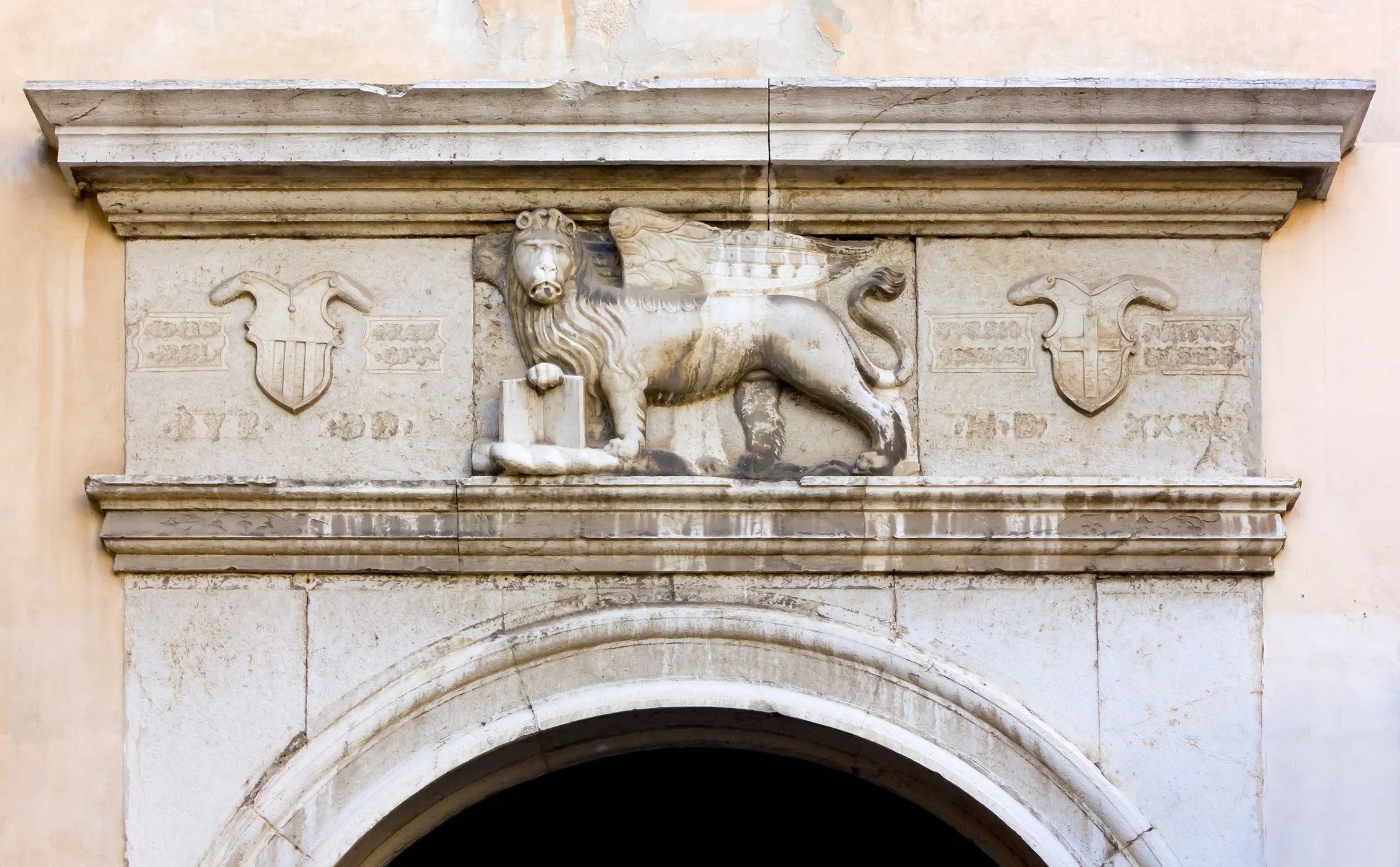
Venetian Winged Lion over Town Gate in Piran
Along the coasts of Slovenia and Istria, the Lion of St Mark is carved into harbour walls and church facades, set above city gates and chiselled into the keystones of loggias that have stood for five hundred years.
Sometimes it holds an open book – the Gospel of Mark, symbol of peace. Sometimes the book is closed – a warning of war. It is always winged. It always watches.
Look more carefully, and you’ll notice something. In some Slovenian and Istrian towns, the carving is crude – the work of a local mason who had never seen Venice, or even a lion, but was handed a description and told to get on with it. In others, it is refined, confident, the work of someone who had at least seen one of the two.
Venice controlled the Adriatic for five centuries. Its influence stretched well beyond the lagoon – along the Dalmatian coast, across the Istrian peninsula, into towns that today bear the flags of Slovenia and Croatia but still carry, in their stones, street layouts, and the tone of their bell towers, the unmistakable mark of the republic that built them. Venice didn’t just conquer these places; it rebuilt them in its own image – the architecture, the administrative machinery, the insistence that a town worth governing should also be worth looking at. Travelling this coast is like following the lion – and to follow the lion is to uncover one of Europe’s most unexpectedly charming journeys, through a world where the Ottoman fleet pushed from the east, the Habsburgs pressed from the north, and Venice, improbably and magnificently, held the line.
Piran: The Price of Salt
Slovenia, most visitors assume, means mountains. Alps, glacial lakes, dense forest, the impossible green of the Julian Alps reflected in Lake Bled. It does. But it also means this: forty-seven kilometres of Adriatic coastline – the briefest of windows onto the sea, tucked between the Italian border at Trieste and the Croatian frontier south of Portorož – where warm stone and salt air and the ghost of a Venetian republic still cling to every harbour wall. Piran makes the most extraordinary case for what a small strip of coast can hold.
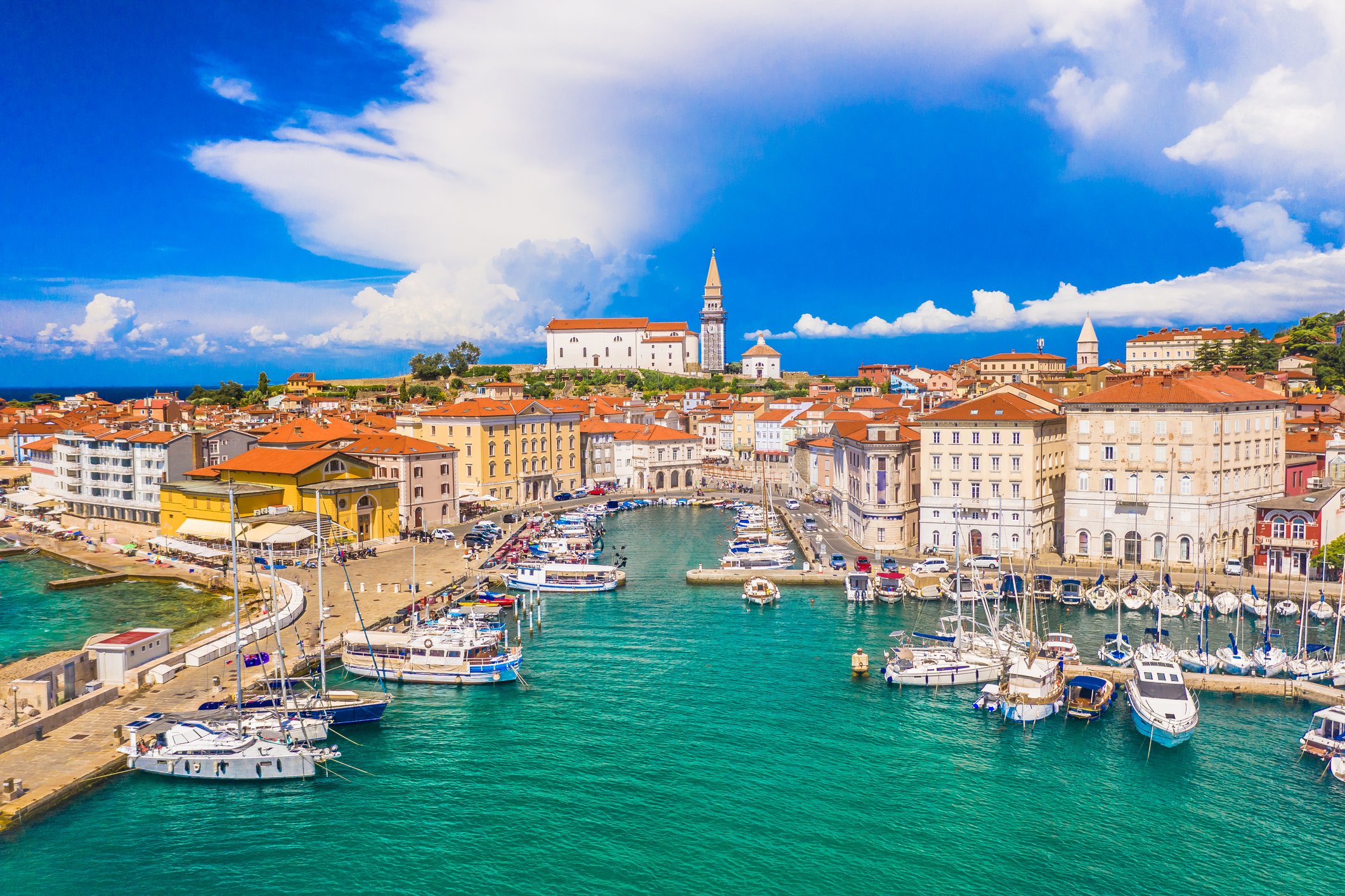
Piran Harbour, Slovenia
The town sits on a narrow peninsula pushing into the Gulf of Trieste, Venetian to its bones. Gothic arches frame slices of blue sea at the end of every side street, and the bell tower of St George – modelled directly on the Campanile of San Marco – rises above the rooftops as it has for four hundred years. In the centre, Tartini Square – named for the Baroque violinist Giuseppe Tartini, who was born here in 1692, when Piran was still unmistakably Venetian – is where the town's civic life still gathers. On its northern edge stands the Venetian House, a fifteenth-century Gothic palace built, according to local legend, by a Venetian merchant for a young woman from Piran. The townspeople gossiped; the couple had their answer carved into the stone between the upper windows, beneath a lion: Lassa pur dir – let them talk. Five centuries later, the inscription is still there– the gossip has long since stopped.
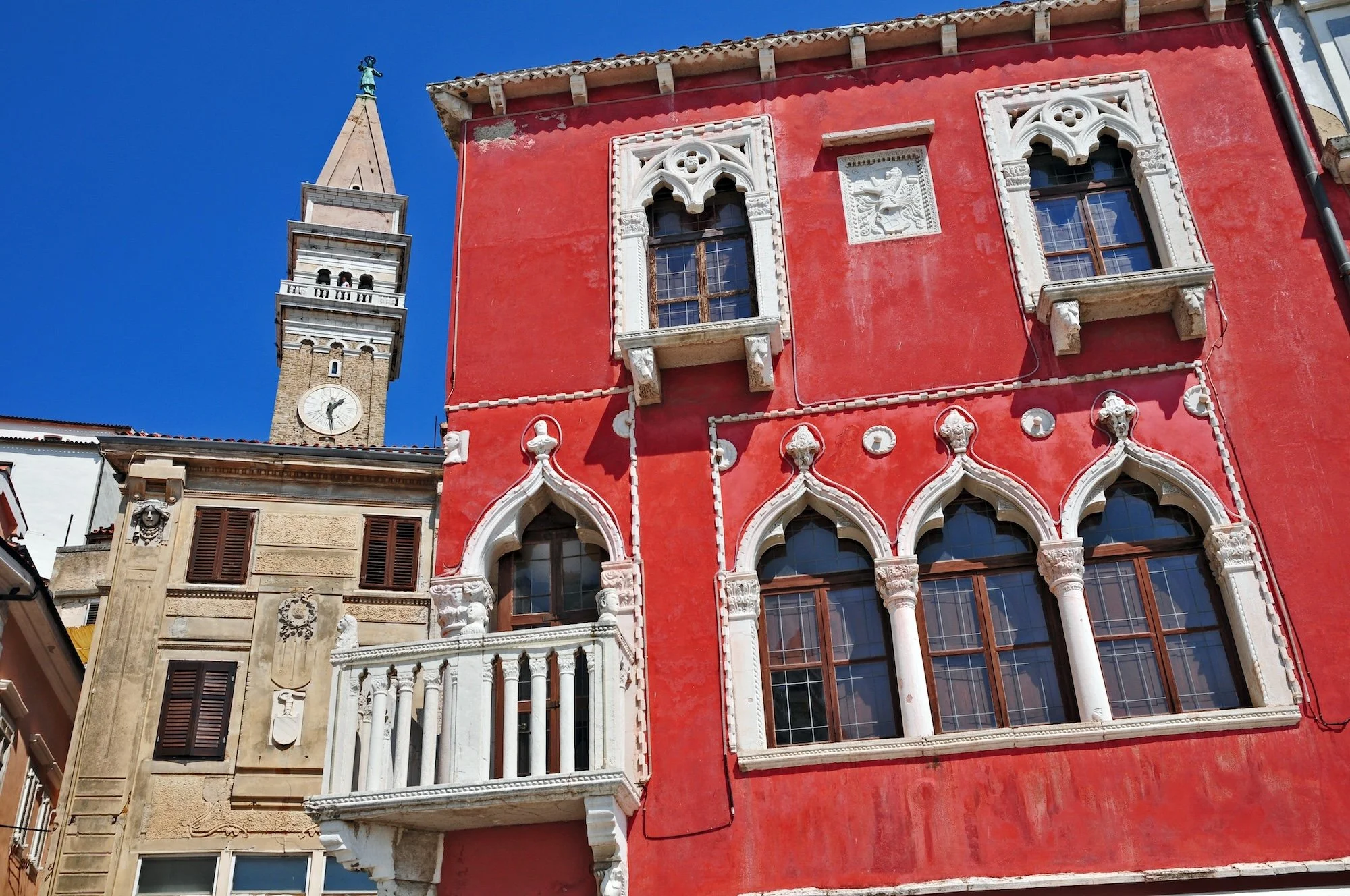
The Venetian House, Piran
For Venice, Piran wasn’t simply beautiful; it was lucrative.
The salt pans at Sečovlje, just south of the town, were among the most valuable on the Adriatic. Salt in the medieval world was not a condiment – it was a strategic commodity. It preserved armies on campaign and let trading empires cure fish for export across a continent. It was worth its weight in gold, and sometimes more. Venice controlled the trade across the northern Adriatic with calculated ferocity, suppressing competing production and managing Piran’s pans as a core part of imperial infrastructure.
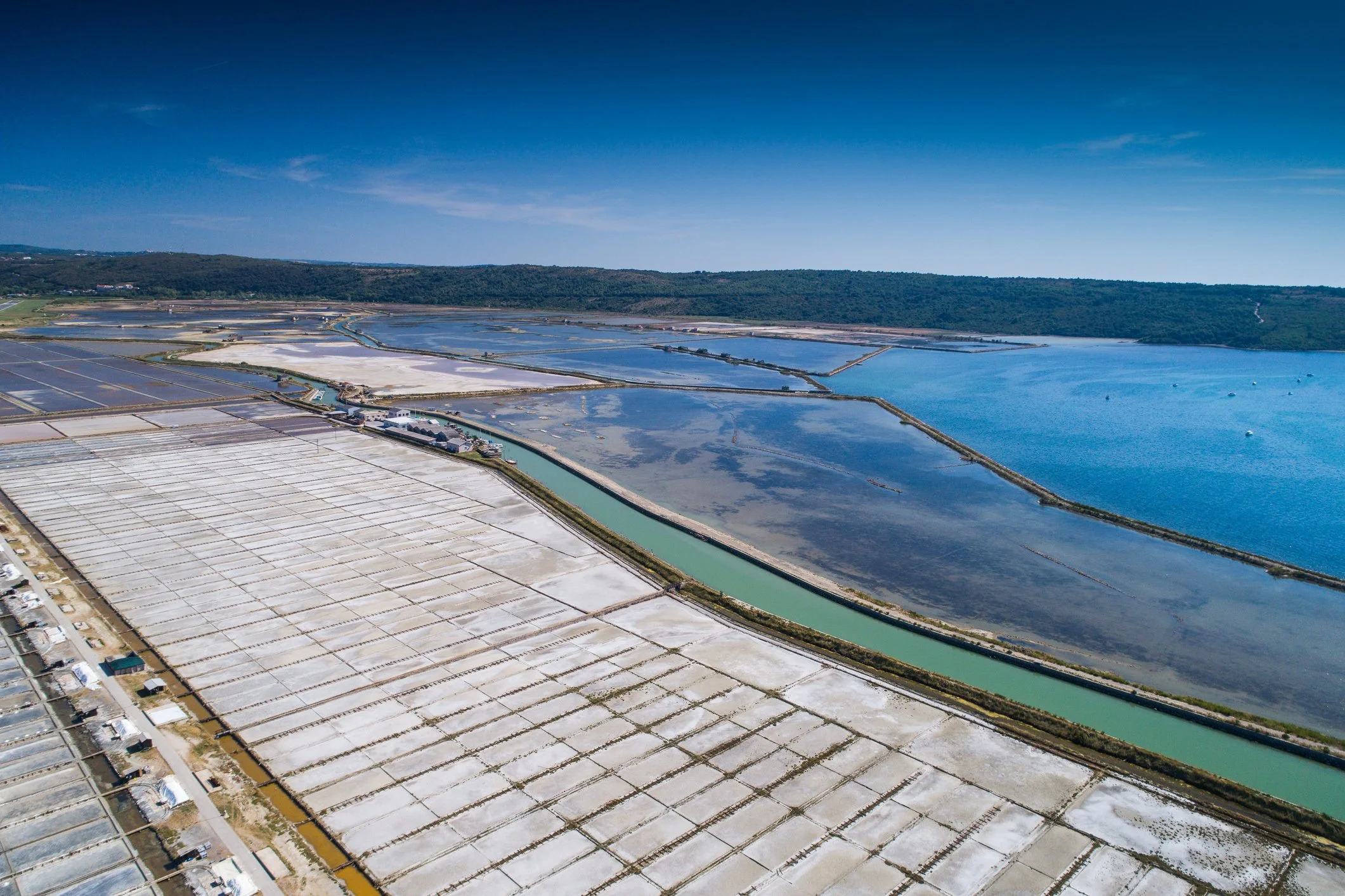
Salt evaporation ponds in Sečovlje, Slovenia
Climb to the medieval walls, built to defend Piran from the Ottoman naval fleets, and the full picture opens up. The lion presides here over the town hall, the city gate, the loggia where Venetian merchants conducted their business in the open air, settling contracts and disputes. The view from the ramparts – the Gulf shimmering below, the Istrian coast curving south towards Croatia, the faint suggestion of Venice somewhere beyond the western horizon – is among the most quietly arresting on the Adriatic.
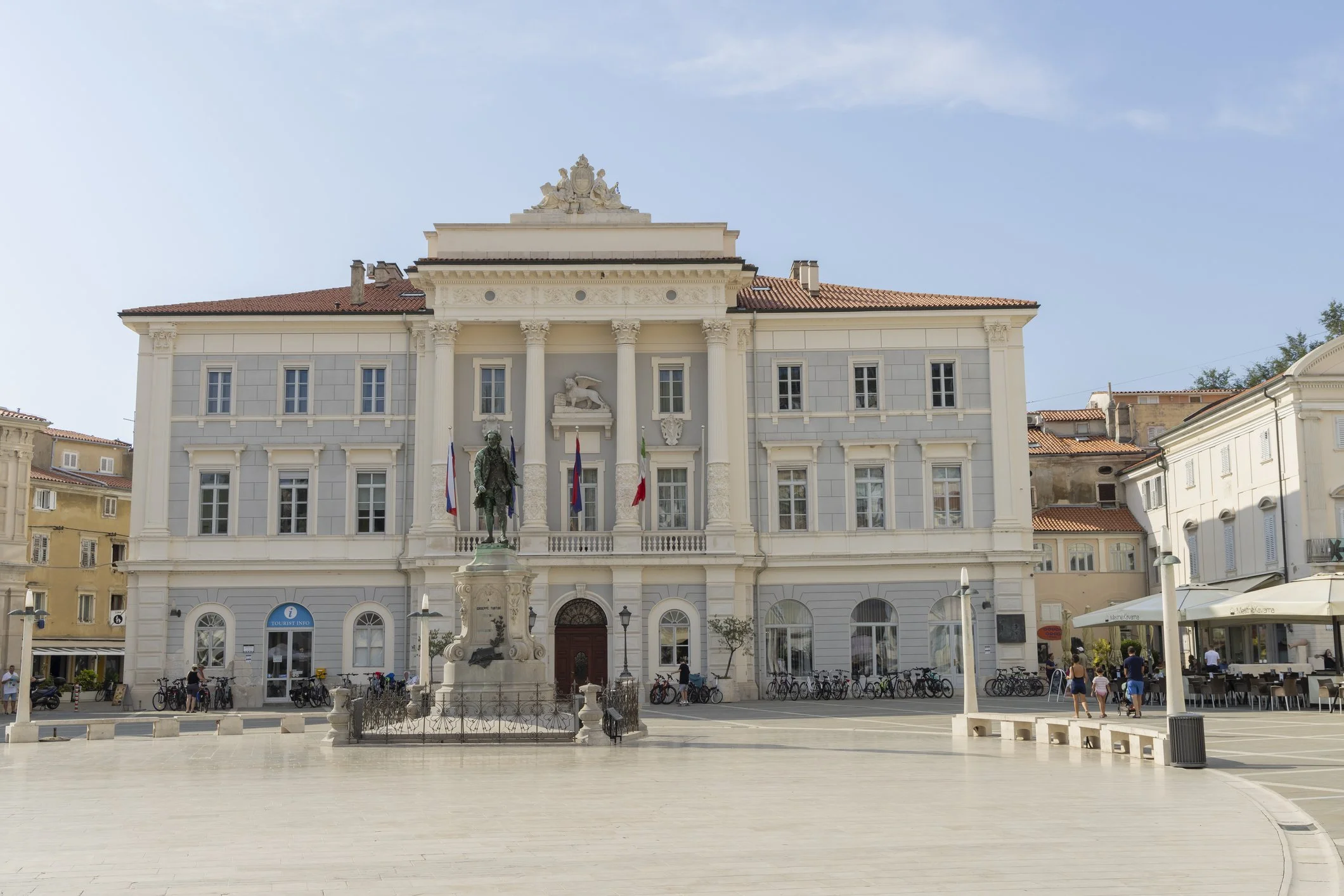
Venetian Lion on the Town Hall, Guiseppe Tartini Square, Piran
Koper: Capo d’Istria
A short drive up the coast, Koper wears its history in its name. Capo d’Istria – the head of Istria – still clings to the city in Italian alongside its Slovenian identity, a linguistic fossil of five centuries of Venetian administration. This was the administrative capital of the entire Istrian peninsula, the seat from which Venice governed the northern Adriatic – and governed it with a system designed, above all, to prevent the governors from becoming too comfortable.
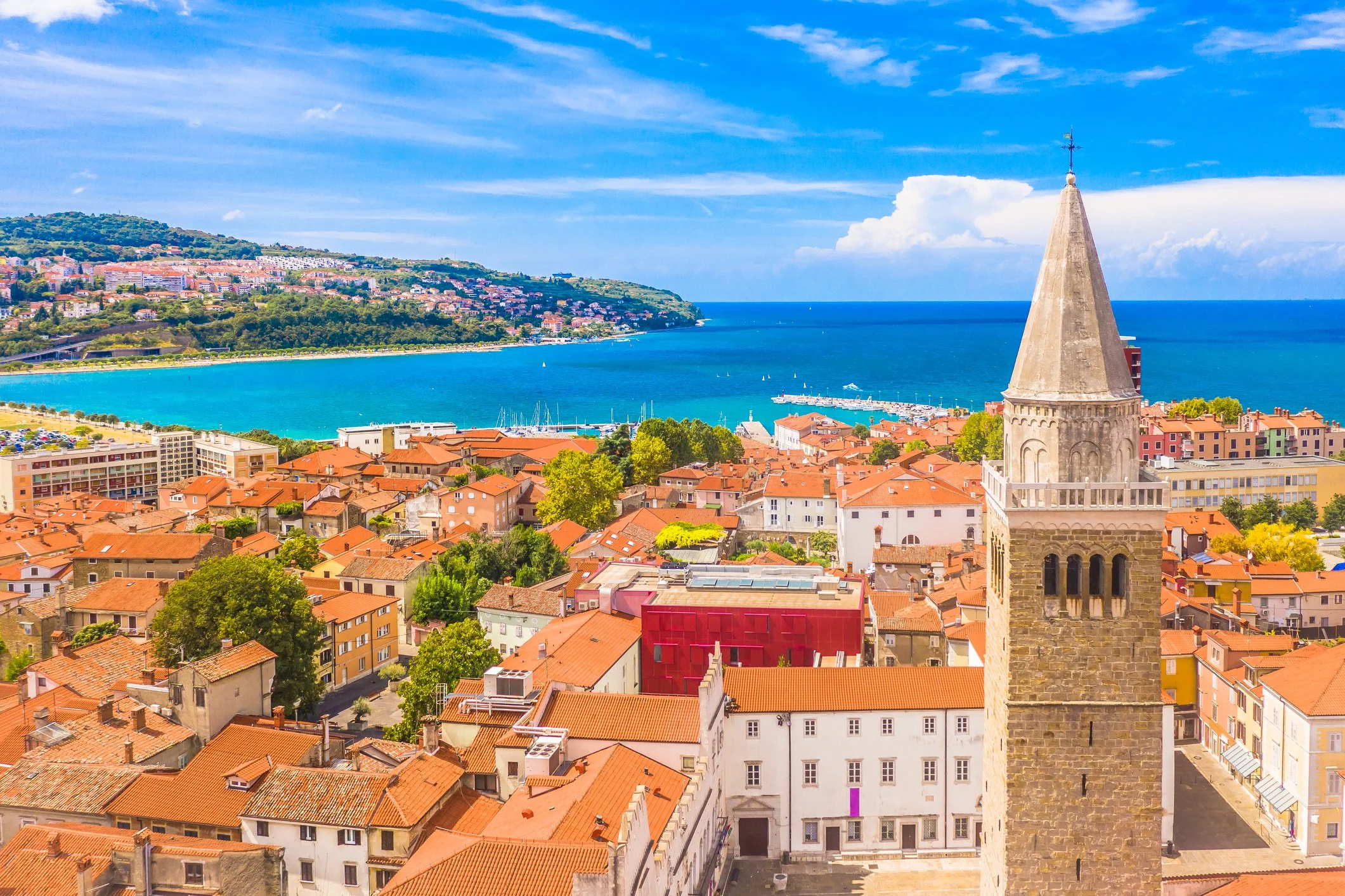
Coastal City of Koper, Slovenia
Venice appointed rectors to administer its territories, and the terms were strict: two years, no extensions, no family permitted to accompany you, no purchase of local property. At the end of your tenure, you submitted to a formal audit – every decision, every expenditure, every complaint examined before you were permitted to return to Venice. It was a system that produced competent, transient administration rather than entrenched local power, and it worked for centuries. The Praetorian Palace on what is now Tito Square was where these men governed: Gothic ground floor from the fourteenth century, Renaissance loggia above it from the fifteenth, a stone record of the republic’s long tenure.
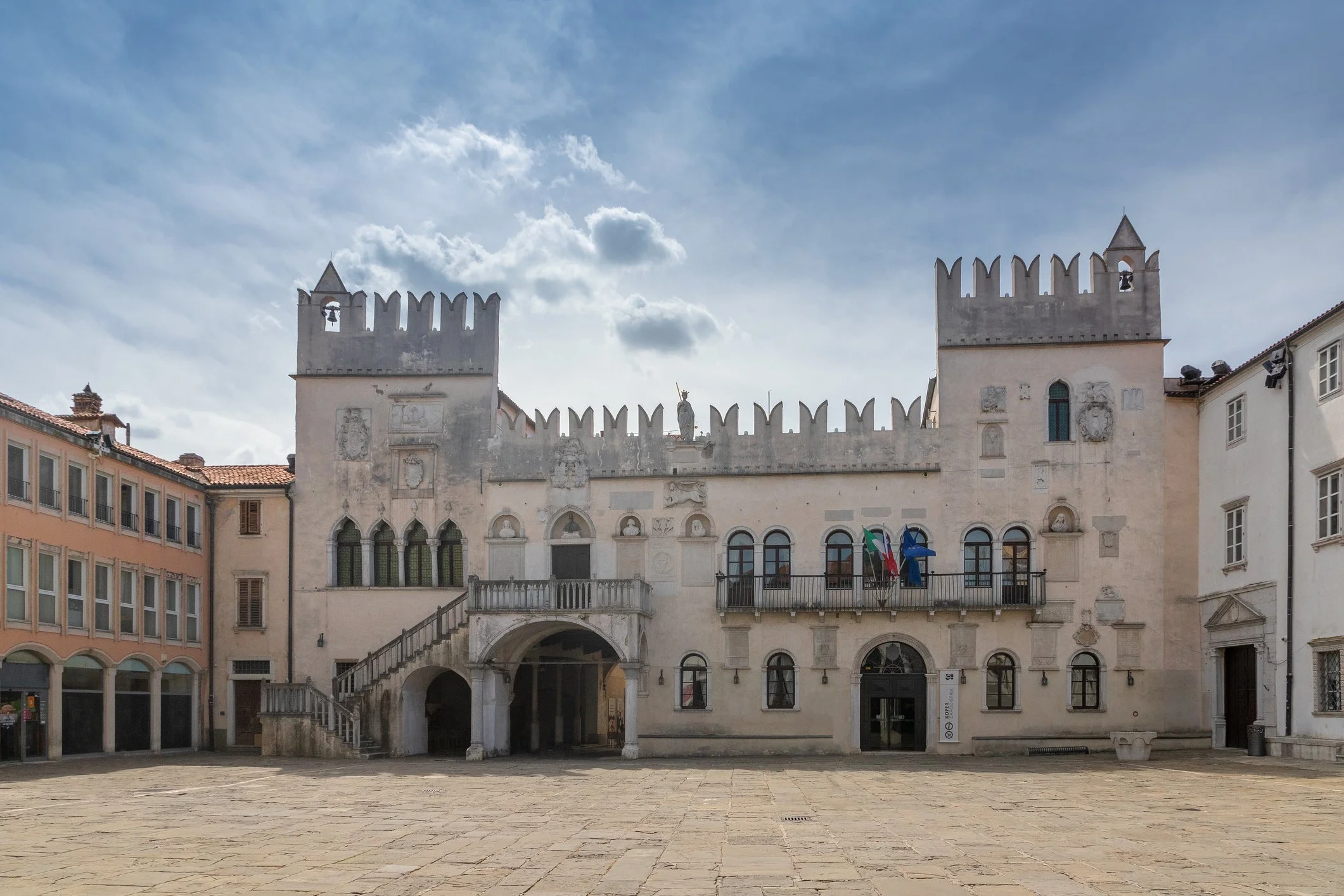
Praetorian Palace in Koper, Slovenia
The square itself is one of the finest medieval civic spaces on the northern Adriatic. The Cathedral of the Assumption rises beside the palace, its campanile visible from the harbour below. Beyond the square, the old town opens into cobbled lanes and Gothic doorways, the Da Ponte fountain recalling the Rialto Bridge in miniature, the Muda gate – built in 1516, the sole survivor of twelve that once controlled access – still marking the entrance to the old city. For most of its history, Koper was a fortified island; the surrounding channel was only filled in later, and the Muda gate was the town's single road entrance. Lions have adorned the town's facades for five centuries now, watching over rather more of Slovenia's history than anyone could have anticipated.
Into Istria: The Peninsula Venice Rebuilt
The Istrian peninsula was the heartland of Venice's Adriatic empire – and its buffer. Ottoman raids had depopulated much of the interior by the sixteenth century, and Venice resettled the emptied villages with families from its Dalmatian and Greek territories, remaking the peninsula's population as deliberately as it remade its architecture. The land was so thoroughly shaped by five centuries of Venetian rule that the Habsburg administration that succeeded it, the Yugoslav state that followed, and the independent Croatia of today have all left their marks without erasing the essential character of the place. Venice drew heavily on the land: the white limestone of these hills was shipped across the Adriatic to build Venetian palaces, pave St Mark's Square, and raise the Rialto Bridge itself; the oak forests of the interior were felled to build the republic's fleets. Hilltop towns, harbour loggias, the olive groves and vineyards that supplied Venice with oil and wine – this is the landscape the republic made, and it endures. The soil is the distinctive red terra rossa of the Mediterranean limestone karst.
Rovinj is perhaps the most immediately seductive of the Istrian towns: tall, narrow houses in burnt orange and faded yellow climbing a promontory above the sea, crowned by the Baroque church of St Euphemia whose campanile – yet another near-replica of the one in San Marco – is visible from out at sea. It was built that way deliberately – Venice wanted its towers seen, wanted sailors and merchants and rivals to know whose world they were entering the moment land appeared on the horizon. What the tower doesn’t reveal is that until 1763, Rovinj was an island. The Venetians simply filled in the channel and connected it to the coast – Venice, when it found geography inconvenient, tended to redraw it.
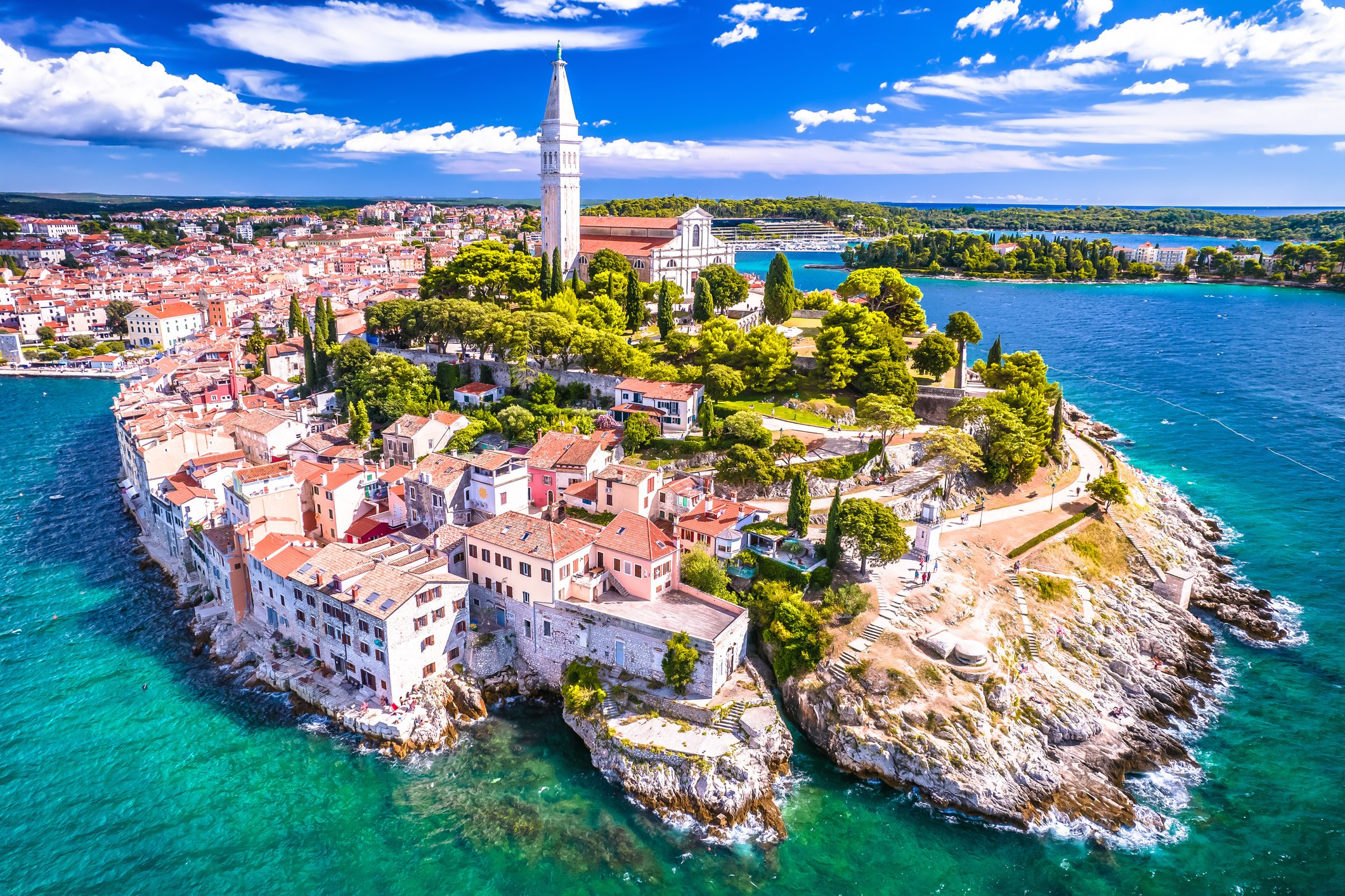
Church of St Euphemia, Rovinj
The Habsburgs eventually absorbed all of this – Istria passed to Austria after the fall of the republic in 1797 – but they were inheriting something they could admire without being able to replicate. The Austrians were efficient administrators and capable engineers. They were not, in the Venetian sense, builders of beautiful towns. But they let the lion remain above the gates, arches, and palace in the old city.
Pula: Before the Lion
At the southern tip of the peninsula, Pula belongs to an older world entirely.
The Roman amphitheatre rises from the ground with all four exterior walls intact – three stories of arches and openings, twenty thousand seats, the warm honey-coloured limestone holding the afternoon light as it has for two millennia. Gladiators fought here. Wild animals – bears, lions, creatures shipped at great expense from across the Roman world – were released onto the arena floor. At the height of empire, Pula was a cosmopolitan port, and the amphitheatre was where the city gathered – for spectacle, for ritual, for the reassurance that Rome’s reach extended even here.
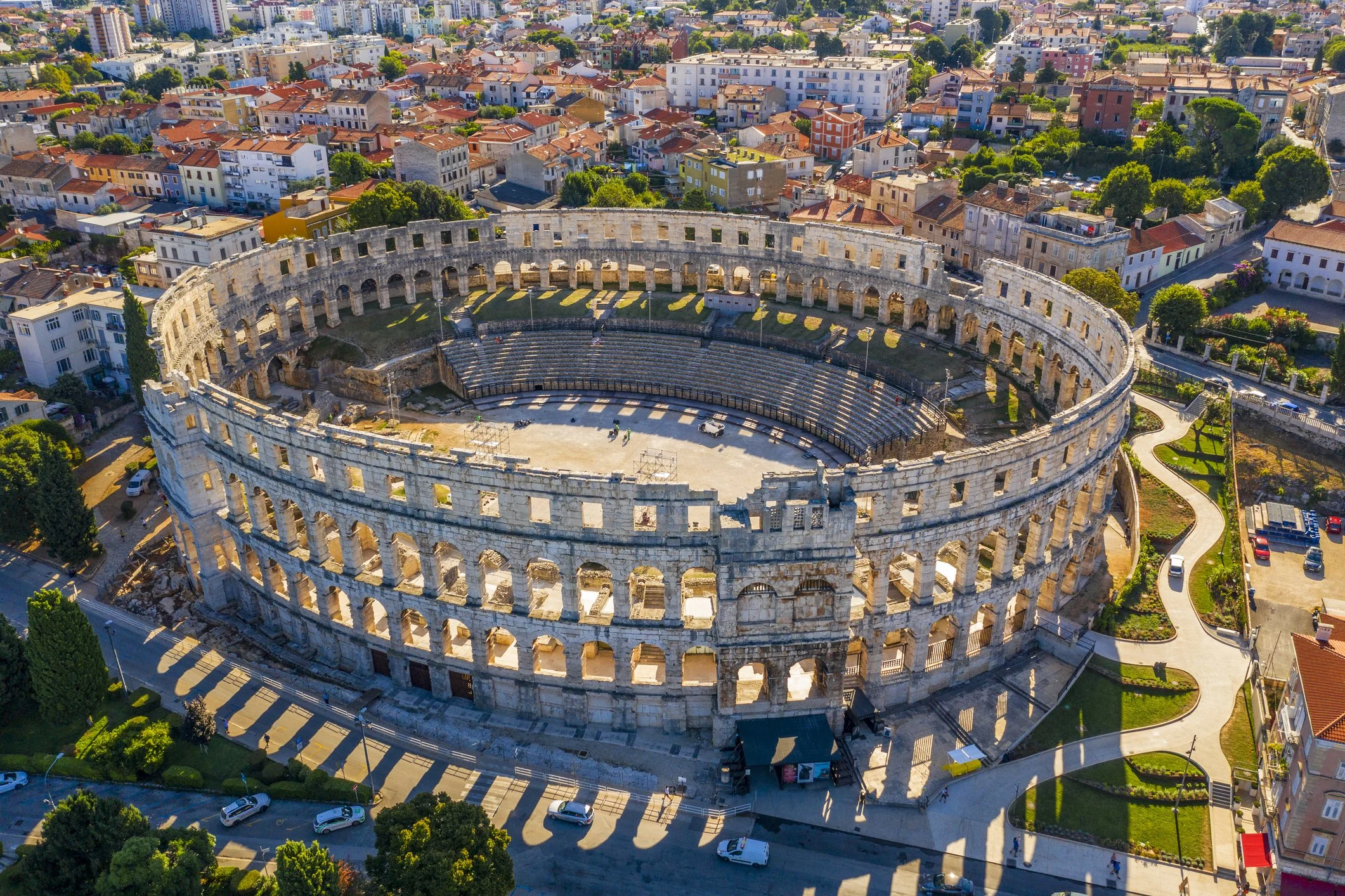
Pula Arena, Croatia
When Venice took the city, it inherited a building that eclipsed anything the republic had ever raised. For a time, the amphitheatre served as an open-air market, merchants trading on the arena floor beneath the ancient arches. Later, the Senate debated something more drastic: stripping the structure entirely for building stone and shipping it back to the lagoon. They were serious. But the amphitheatre survived because of a single nobleman: Senator Gabriele Emo successfully opposed this decision in the Venetian council, and out of gratitude, a stone plaque was built into the northwestern tower of the amphitheatre with his family coat of arms and a Latin inscription: “The entire Pula citizenry thanks Gabriele Emo, son of Peter, the excellent and most illustrious Venetian senator, for the eternal existence of the monument, the old city amphitheatre, 1583”.
Venice drew everything else from this land. The olive groves covering these limestone slopes were among the most valued in the Venetian world – Istrian oil, pale gold and faintly peppery, traded from Venice's warehouses to markets across the Mediterranean. The Malvazija, the indigenous white wine of the peninsula, dry and mineral with something of the salt air in its finish, moved on Venetian merchant galleys to courts and kitchens across Europe. Istrian truffles are a more recent story – the oak forests inland have always harboured them, but for generations locals dismissed them as stinky potatoes and fed them to the pigs. It took the modern world to recognise what was underfoot.
Sit outside the amphitheatre with a glass of Malvazija and a plate of truffle pasta, and the full picture of what this peninsula has meant to Venice and to everyone since comes quietly, and pleasurably, into focus.
Echoes of the Republic
No empire lasts forever, and by the end of the eighteenth century, Venice was running out of time. Swept up in the wars that followed the French Revolution, Venice found itself powerless against Napoleon's forces. On 12 May 1797, in a half-empty chamber – barely half the patricians bothered to attend, and those who did knew the vote was a formality – the Great Council of Venice dissolved the Most Serene Republic.
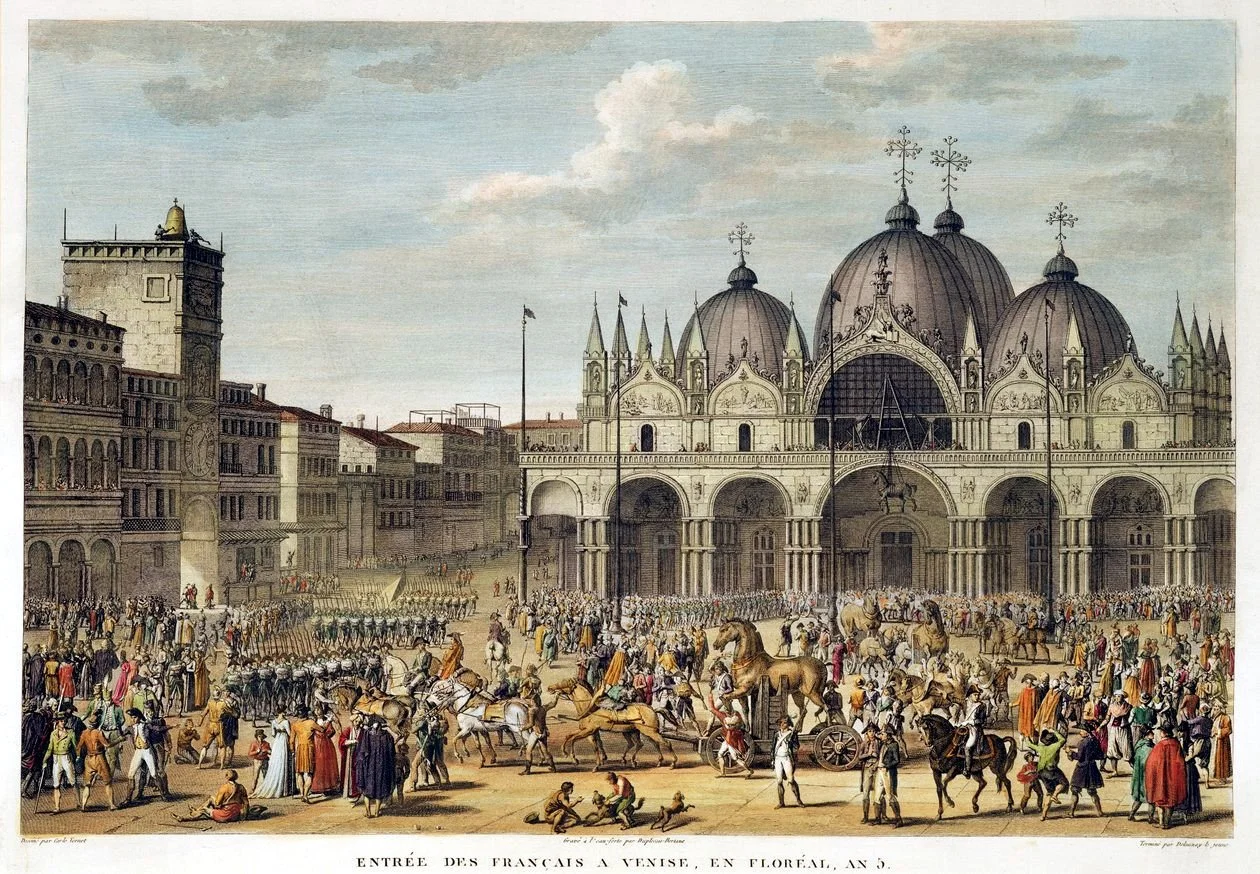
Contemporary engraving of the entry of French troops into Venice in 1797
It had lasted eleven hundred years. The last Doge, Ludovico Manin, returned his ducal cap and withdrew to his palazzo on the Grand Canal, where he refused to answer the door even to friends. Five months later, Napoleon traded Venice and all its Adriatic territories to Austria in the Treaty of Campo Formio – Istria, Dalmatia, and the Slovenian coast were handed over like furniture in a diplomatic settlement. The towns that had lived under the lion for five centuries became Austrian overnight. What followed was two centuries of changing flags – Austria, Napoleon again briefly, Austria once more, Italy after the First World War, Yugoslavia after the Second, and finally independence in 1991.
Yet Venice remains firmly part of the region's fabric. The salt pans at Sečovlje still produce salt by the same ancient methods, harvested in the same flat white crystals that once moved on Venetian galleys across the Mediterranean. The campaniles still face the sea. The olive groves yield the same oil that once filled Venetian warehouses, and the Malvazija grows on the same limestone slopes. The republic is gone, but what it made of the Slovenian and Istrian coast – the harbours and squares and loggias, the layered palaces and the lion above the gate – endures with a richness and a warmth that continue to reward the curious traveller, as they have done for centuries.
Tour Slovenia
in 2026
Join Dr Lauren Mackay this September as we embark on a 17-day historical journey through Slovenia and Istria – where the cultural, architectural and culinary legacies of the Holy Roman Empire, the Ottomans and Venetians intersect.
