Later Byzantine Art
Its formal principles, historical setting and spiritual meaning
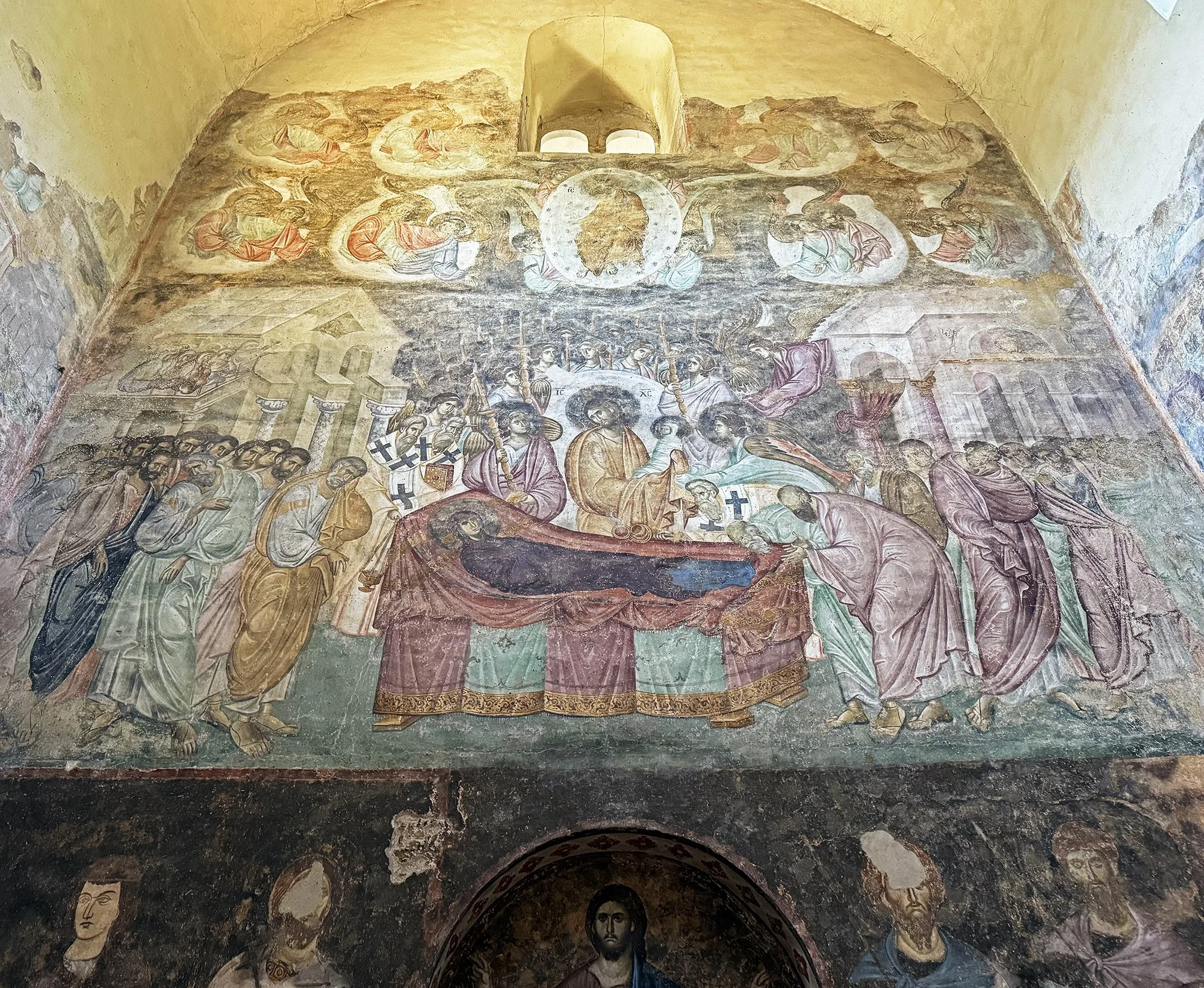
‘Dormition of the Mother of God’, c.1265, in the Sopoćani Monastery
High on the interior western wall of a church building deep in the fir-clad heartland of old Serbia, Christ looks down upon the faithful at the centre of a throng of angels and apostles mourning the death or “falling asleep” (the koimēsis or dormition) of his mother.
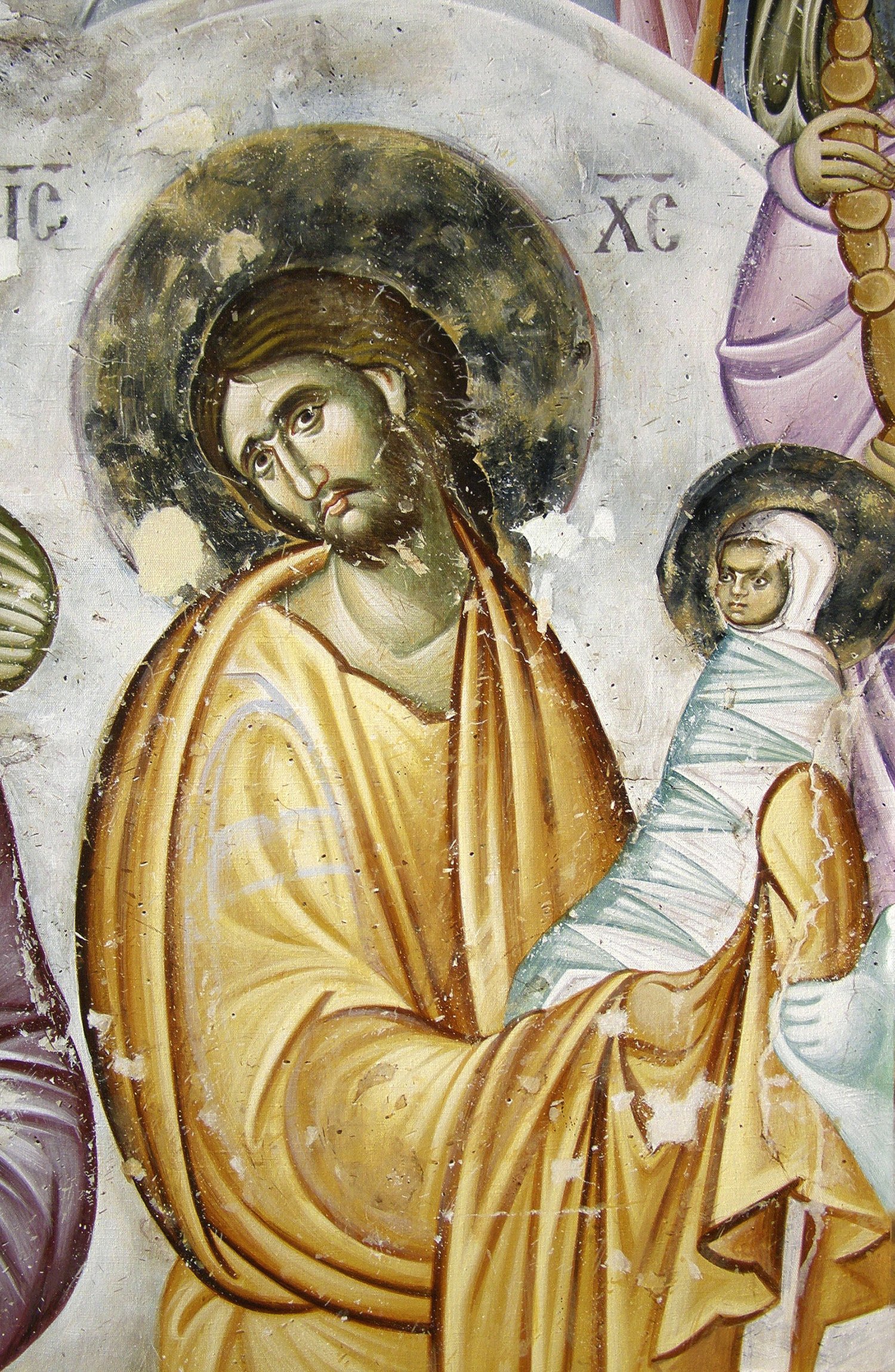
At the Sopoćani Monastery in Doljani, and robed in a knee-length porphyry cloak, Mary herself is stretched out on a couch draped in red and green silks, her nimbed head propped up at one end. Standing behind, her divine Son holds her soul in his hands in the form of a baby in swaddling bands. While no emotion is betrayed by the Virgin who has fallen asleep, Christ’s eyes overflow with it, as if in the death of his mother he, as eternal Word made flesh, laments the mortality that has infected humankind since the Fall, when Adam subjected his descendants to the law of death.
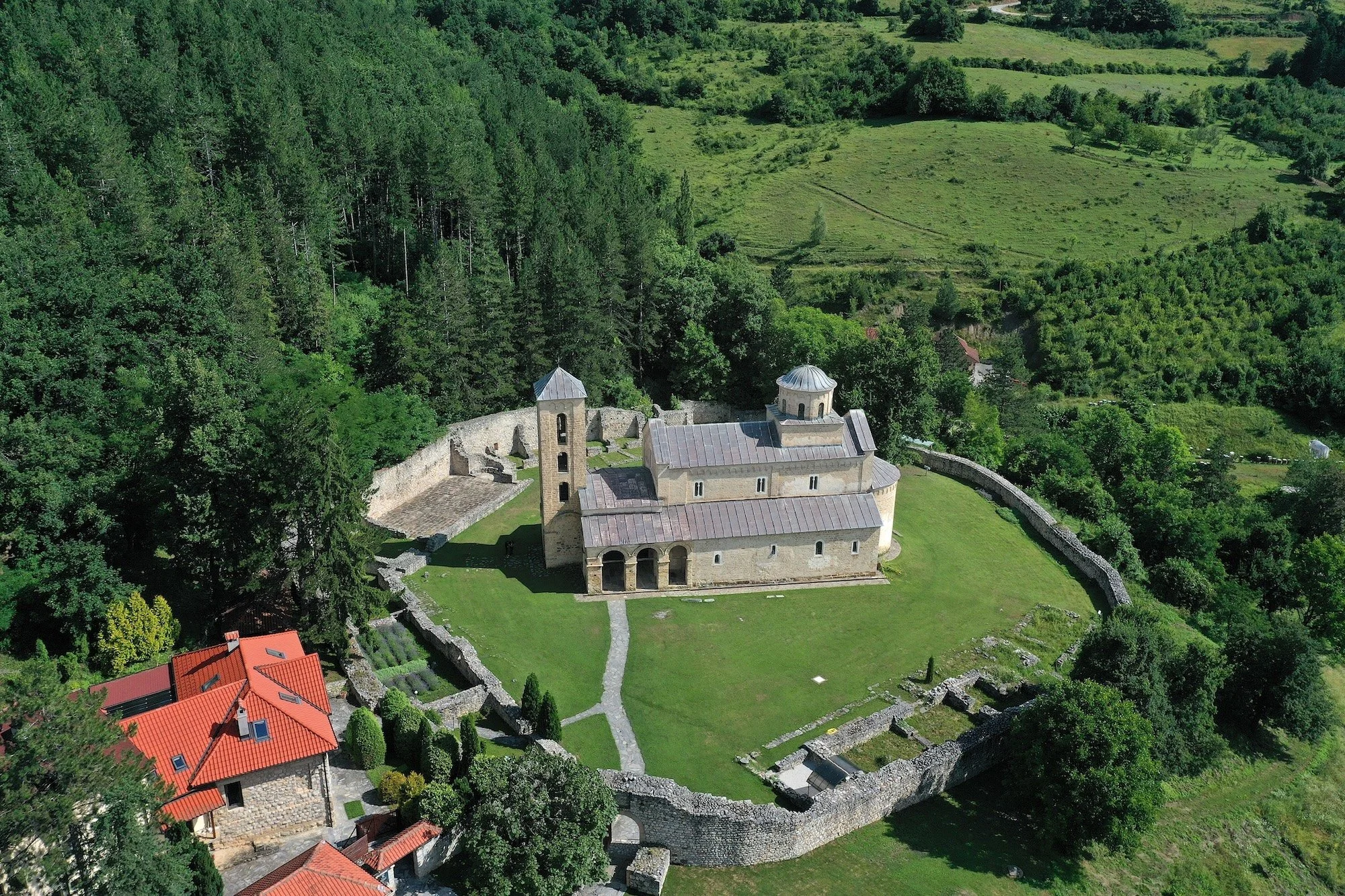
Sopoćani Monastery – Doljani, Serbia
Of course, as Christians, the Byzantine masters who painted the scene will have known that Christ’s own death and subsequent resurrection undid this subjection. But the fresco’s power lies in the honesty with which the human response to the continuing fact of death has been depicted nonetheless. Not only are Christ’s eyes full of sadness; around the couch on which Mary lies, the apostles, in flowing robes that suggest the natural volume and movement of their bodies, clutch the sides of their faces and even wipe the tears away with their hands. Witnesses of Jesus’s risen body, the apostles – of all people! – know the flesh will rise. But natural, human grief in the face of death overcomes them anyway.
Byzantine art and especially painting are not generally known for their interest in human emotion and naturalistic representations of the human body. Throughout the central part of the middle ages Byzantine art – the art of the Orthodox Christian empire of Constantinople that represented the continuation of the Roman empire in the northeastern Mediterranean – was marked by its strict monumentality. As a rule, its motionlessness subjects – Christ, the Virgin Mary, the saints – betrayed no emotions, their otherworldly features bearing witness to the supercelestial world beyond time and space in which they were now situated. To obtain this effect, Byzantine artists eschewed all but the slightest interest in the third dimension – volume, depth – of a human form that was always rendered longer and thinner than a naturalistic account of its proportions would have required, as if the image itself insisted that the viewer never forget that it was a symbol rather than reality.
The frescoes of the Cathedral of Holy Wisdom in Ohrid in modern Northern Macedonia Good are good examples of this “conservative” middle Byzantine style. Other examples include the mosaics (from c. 1100) of the church at Daphne, outside Athens, or those (c. 1000) of the Monastery of Hosios Loukas in the Peleponnese. Although somewhat later (c. 1190), the mosaics at Monreale in Sicily conform to the same principles.
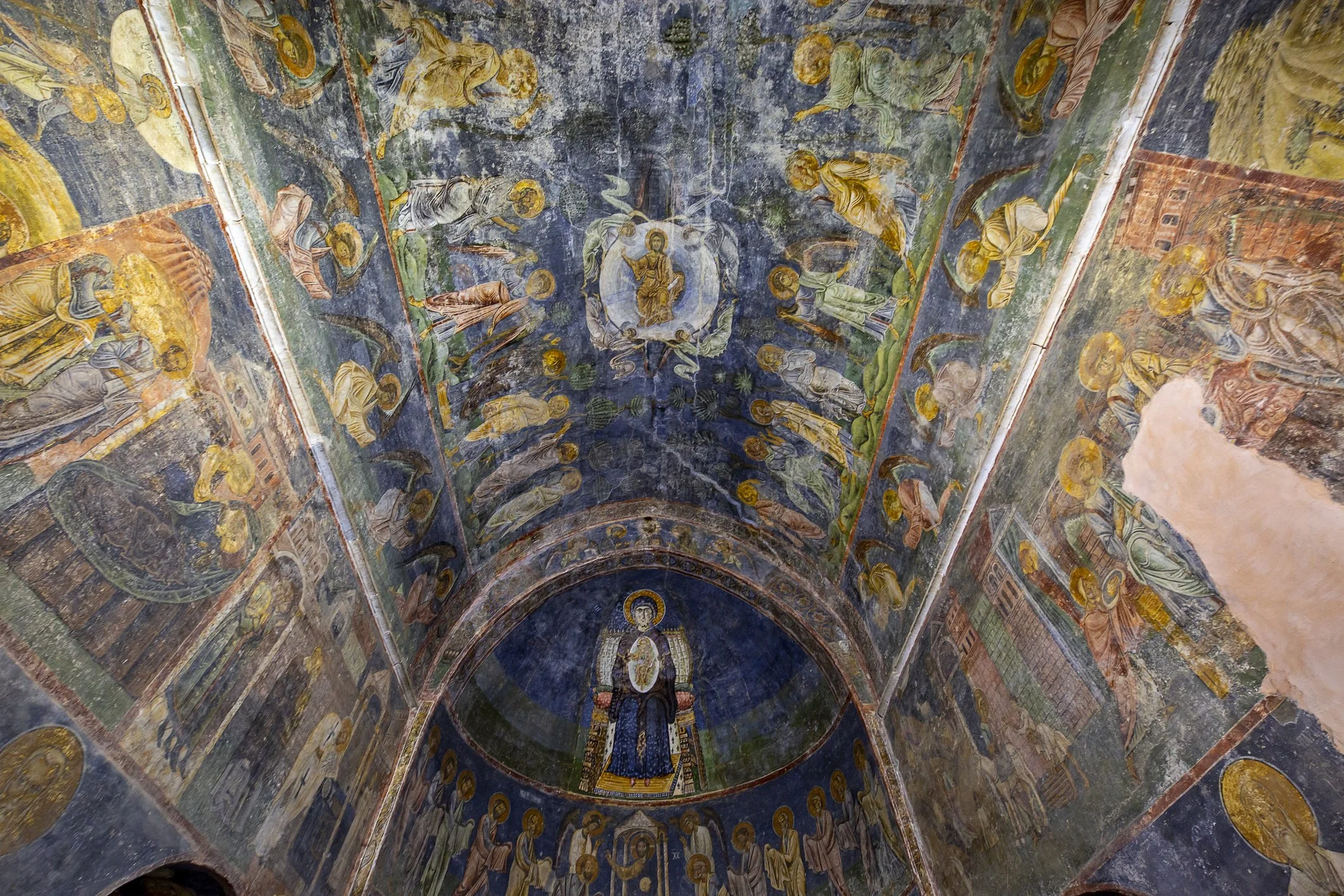
The Cathedral of Holy Wisdom (Church of St. Sophia) in Ohrid, North Macedonia
Painted in 1265, however, Sopoćani’s Dormition of the Virgin upends all these rules, as we have seen. Not only that: the masters who executed it did so almost fifty years before Giotto’s more famous experiments with emotion, volume, and depth inaugurated the birth of the Italian Renaissance. Indeed, Sopoćani’s Dormition of the Virgin is the greatest early work of that other renaissance – the Byzantine – which culminated half a century later in the renowned frescoes and mosaics of the Chora Monastery in modern Istanbul.
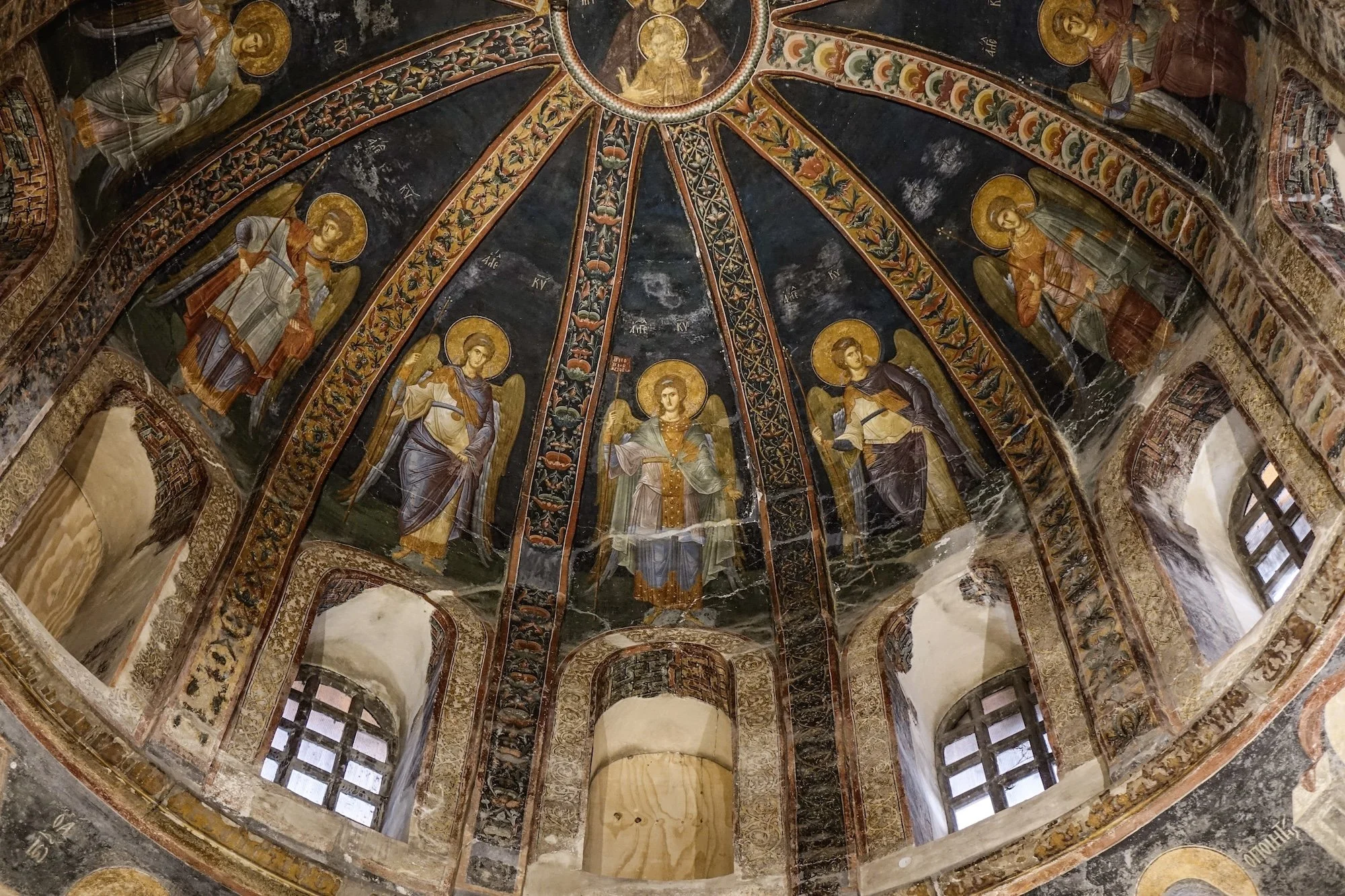
Mosaic of the Virgin Mother with child, north dome of the inner narthex at Church of the Holy Saviour in Chora, Istanbul
What was “Byzantine renaissance” (a term, it is true, not all scholars accept), or the several successive Byzantine renaissances? We may define it (or them) as the renewal first at the beginning of the twelfth and then again at the end of the thirteenth centuries of the study of classical (especially Platonic and Neoplatonic) philosophy as a source of higher wisdom about the nature of God, being, and the human condition, which was accompanied by the rediscovery in the arts of the techniques of Hellenistic illusionism that enabled Byzantine artists to represent the human being with unprecedented psychological sensitivity and spiritual pathos.
Visible in Constantinople from the beginning of the twelfth century and developing in different ways in different parts of the so-called “Byzantine commonwealth” of Eastern Europe, the Byzantine renaissance is not as well-known, to be sure, as the Italian Quattrocento, nor were its monuments as numerous or, in the long run, as influential, cut short as this renaissance was by the fall of Constantinople to the Ottoman Turks in 1453. But its legacy deserves our attention nonetheless both for the intrinsic beauty of the artistic monuments it left behind, a function of Byzantine artists’ unique skill and the particular vision of the mystery of man and the drama of his spiritual calling which they gave expression to, as well as for the influence which Byzantine humanism exerted on the more famous Italian movement which in important respects it helped stimulate and inspire.
Let’s take a closer look at some of these monuments. A day’s drive from Sopoćani across the modern statelet of Kosovo brings the traveller to the Monastery of St Panteleimon in the small North Macedonian village of Gorno-Nerezi, on the bare hills overlooking Skopje. Inside, a fresco reveals the origins of the artistic experiments that would later bloom at Sopoćani. In this case, the scene depicted is that of the Lamentation (the mourning of Mary and the apostles over Christ’s dead body after its removal from the Cross), which was later to become so popular a subject in early Renaissance Italian art because of the opportunities it afforded for depicting emotion.
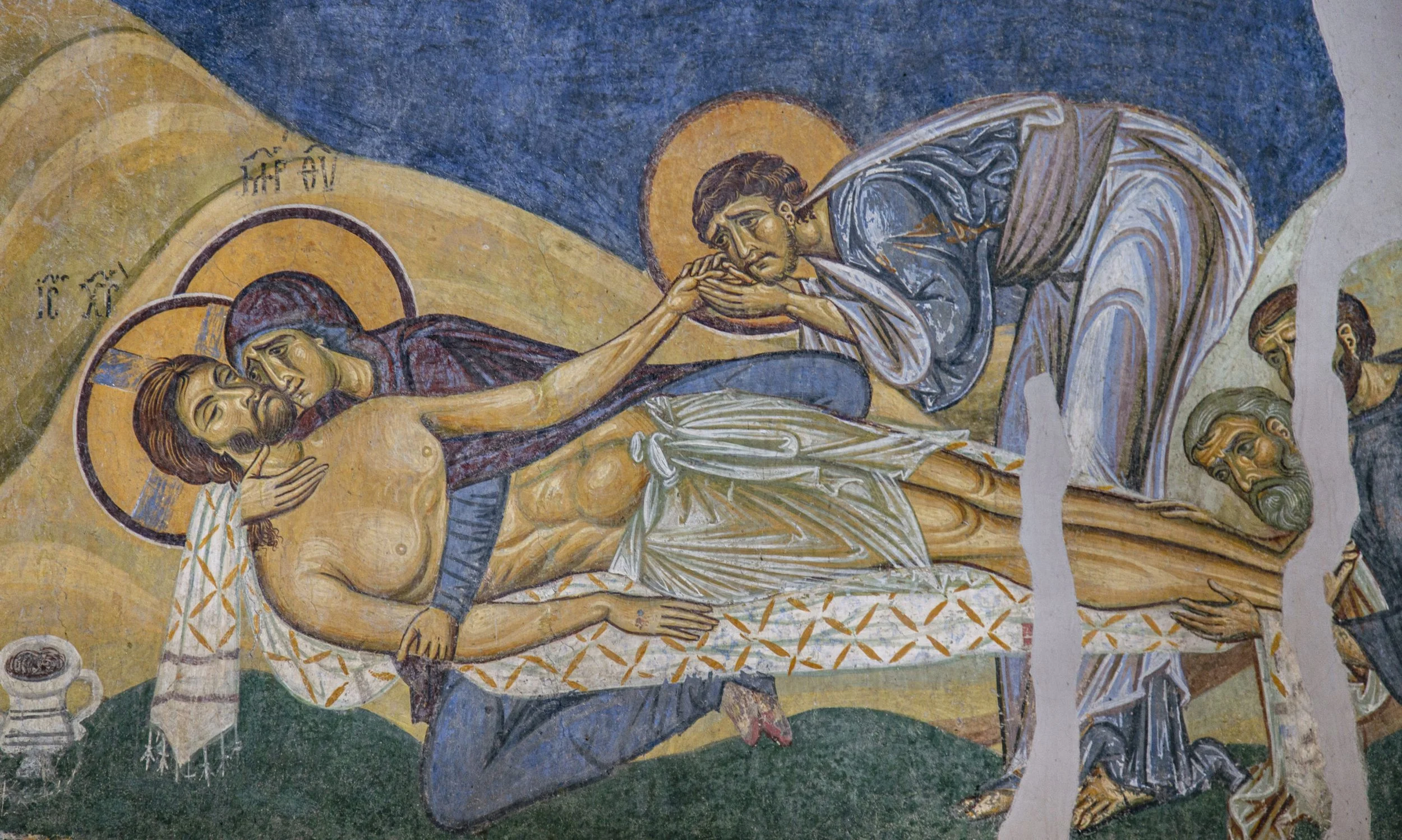
Lamentation fresco in northern crossarm of the naos, 1164, Saint Panteleimon, Gorno-Nerezi
What the St Panteleimon Lamentation allows us to see, however, is that this tradition is not Italian in origin at all, but Byzantine. Eschewing the formality and restraint typical of middle Byzantine art, the painter at St Panteleimon has done nothing to hide the dismay of the woman the Eastern Church typically refers to as the Theotokos, “God-bearer” or “Mother of God”. On the contrary, Mary presses herself up against the rigid body of her dead son, her face lined with the furrows of authentic grief and her eyes full of mourning. Meanwhile, the Apostle John – the “beloved disciple” of the Fourth Gospel – tenderly expresses his own love for Christ: holding the Son of God’s lifeless hand in his own, John brushes it against his cheek while he struggles to understand the events that have taken place. So far as we know, this is the earliest example of the revival of interest in volume, movement, and emotion that would reach its mature expression a century later at Sopoćani – and beyond it, perhaps, in fourteenth- and fifteenth-century Italy. It was painted for a member of the Byzantine imperial family in 1164.
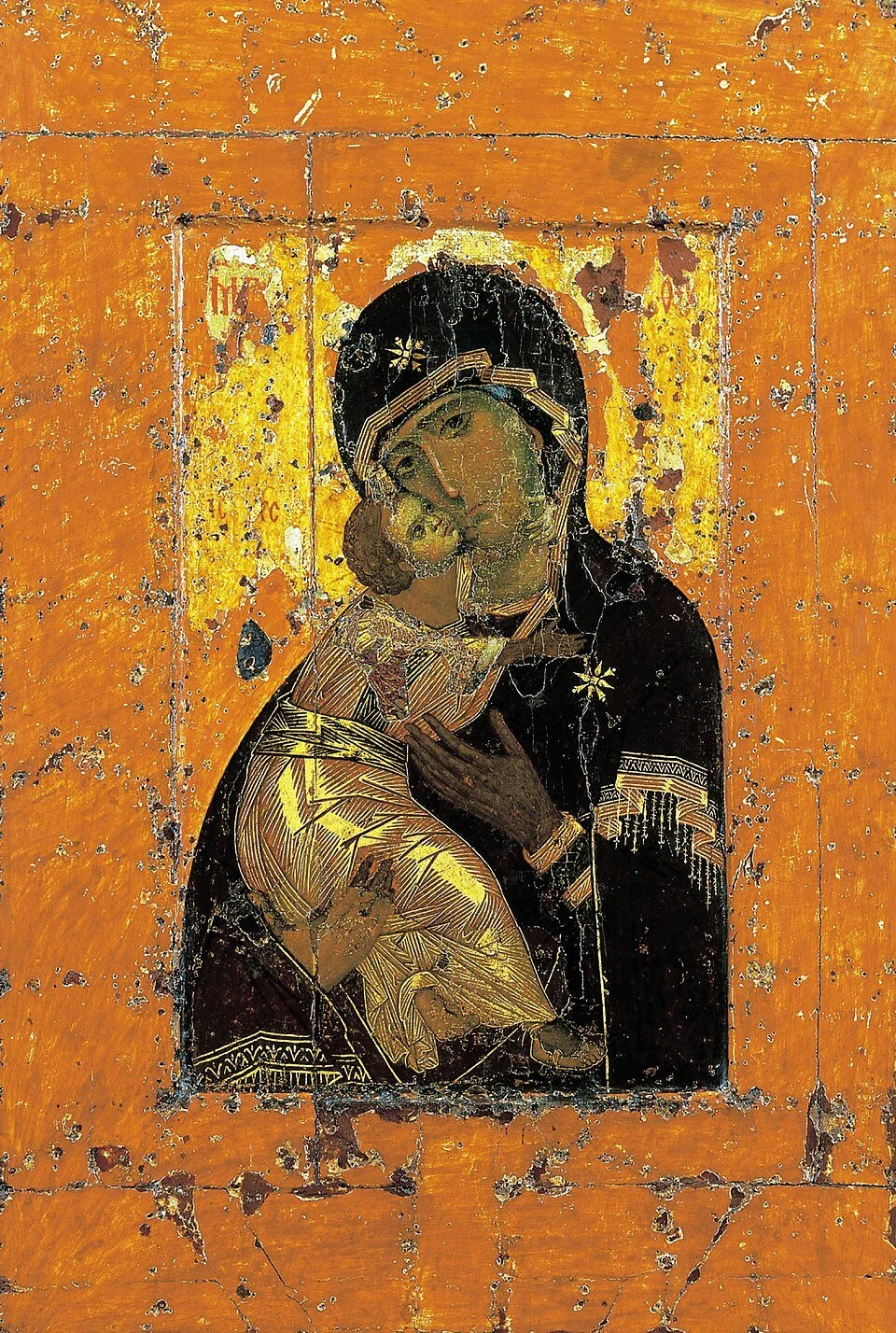
‘Our Lady of Vladimir’, currently held in the State Tretyakov Museum in Moscow
The frescoes of St Panteleimon are exceptionally precious. Without them (and they were discovered for the world of art only in 1888) we would hardly know the Byzantine retrieval of the ancient techniques of Hellenistic illusionism went as far back as it did. Aside from the renowned but only partially intact Deisis mosaic in Hagia Sophia, the only other twelfth-century Byzantine work that can match St Panteleimon’s Lamentation is the icon known as Our Lady of Vladimir, currently held in the State Tretyakov Museum in Moscow but painted in Constantinople circa 1125.
Never before had a panel painter captured the human tenderness of Mary or the truly childlike dependence of the Child on its human mother. No Italian, or indeed Western, painter could have executed anything like it at this time; only in Byzantium could masters capable of rendering human emotion this way be found. The same may be said of the Lamentation at St Panteleimon.
Between the painting of the Lamentation at St Panteleimon at Gorno-Narezi and the Dormition of the Virgin at Sopoćani, the spread of the new, “humanistic” style of the Byzantine renaissance can be traced across the Balkans. After St Panteleimon, it resurfaces at the monastery of Studenica, the burial place of Serbia’s medieval kings, in 1208 – Studenica’s Crucifixion must rank among the most beautiful and arresting ever painted – and then again at another Serbian royal foundation, Mileševa in 1230.

Byzantine blue color and gold of Studenica Monastery frescoes from the early 13th century
Thereafter, the style appeared in medieval Bulgaria, where the now UNESCO-listed Boyana church in the leafy suburbs of the modern Bulgarian capital, Sofia, was painted in 1259. At Peć (1317-24) and then again at nearby Prizren (1307-9), Gračanica (1312), and Decani (1329-35), Byzantine-Serbian artists achieved some of the new style’s most monumentally impressive and psychologically powerful expressions: Gračanica’s St John the Baptist is harrowing in its depiction of the prophet’s concentrated spiritual intensity.
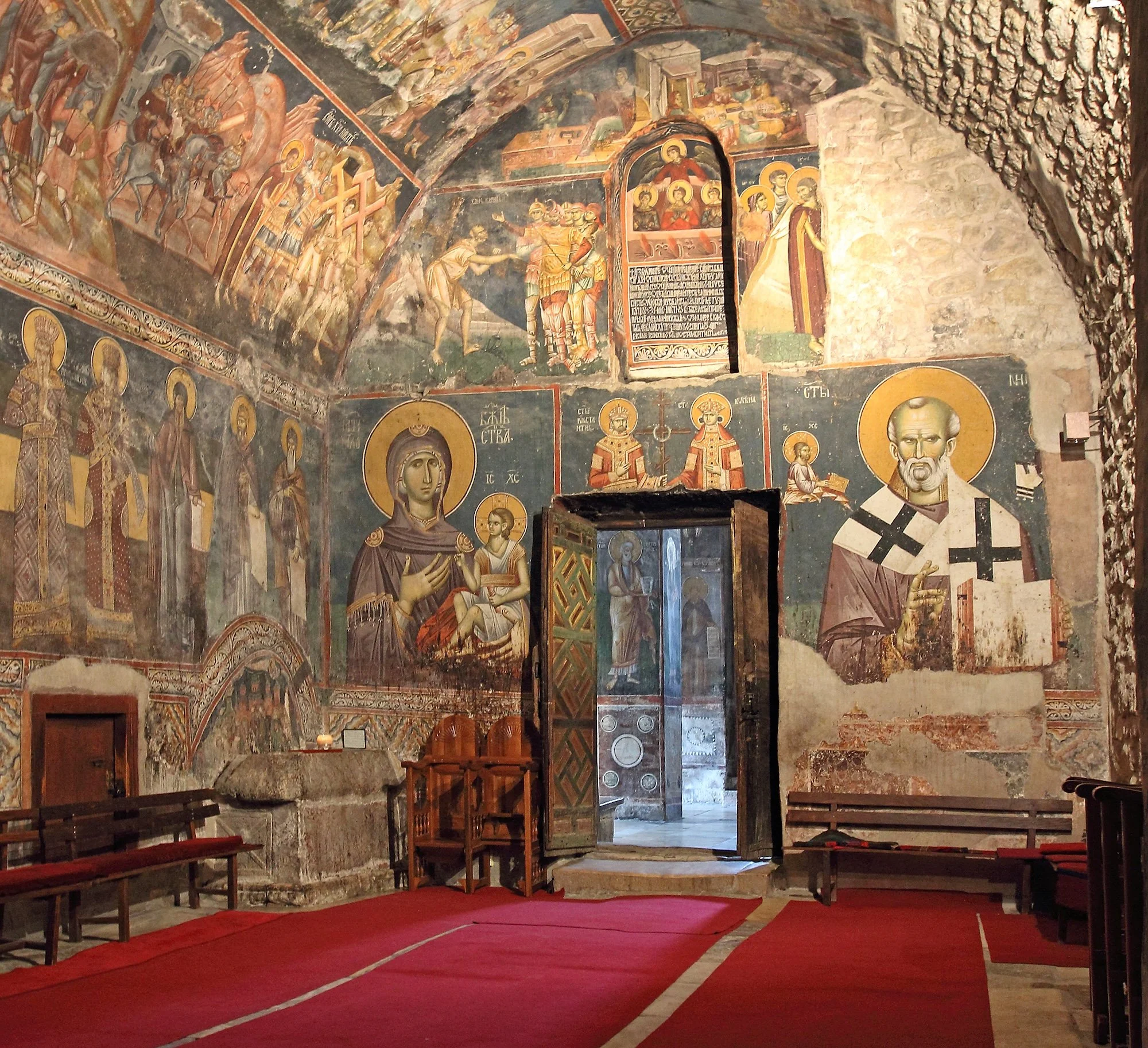
Frescoes of Christ and the Virgin Mary Patriarchate of Pec Kosovo
While all these originally Serbian foundations are now in Kosovo, in Northern Macedonia, Čučer (1307) and Staro-Nagoricino (1317-18) are also noteworthy. (In fact, the very intimate dimensions of the latter make it one of my personal favourites.)
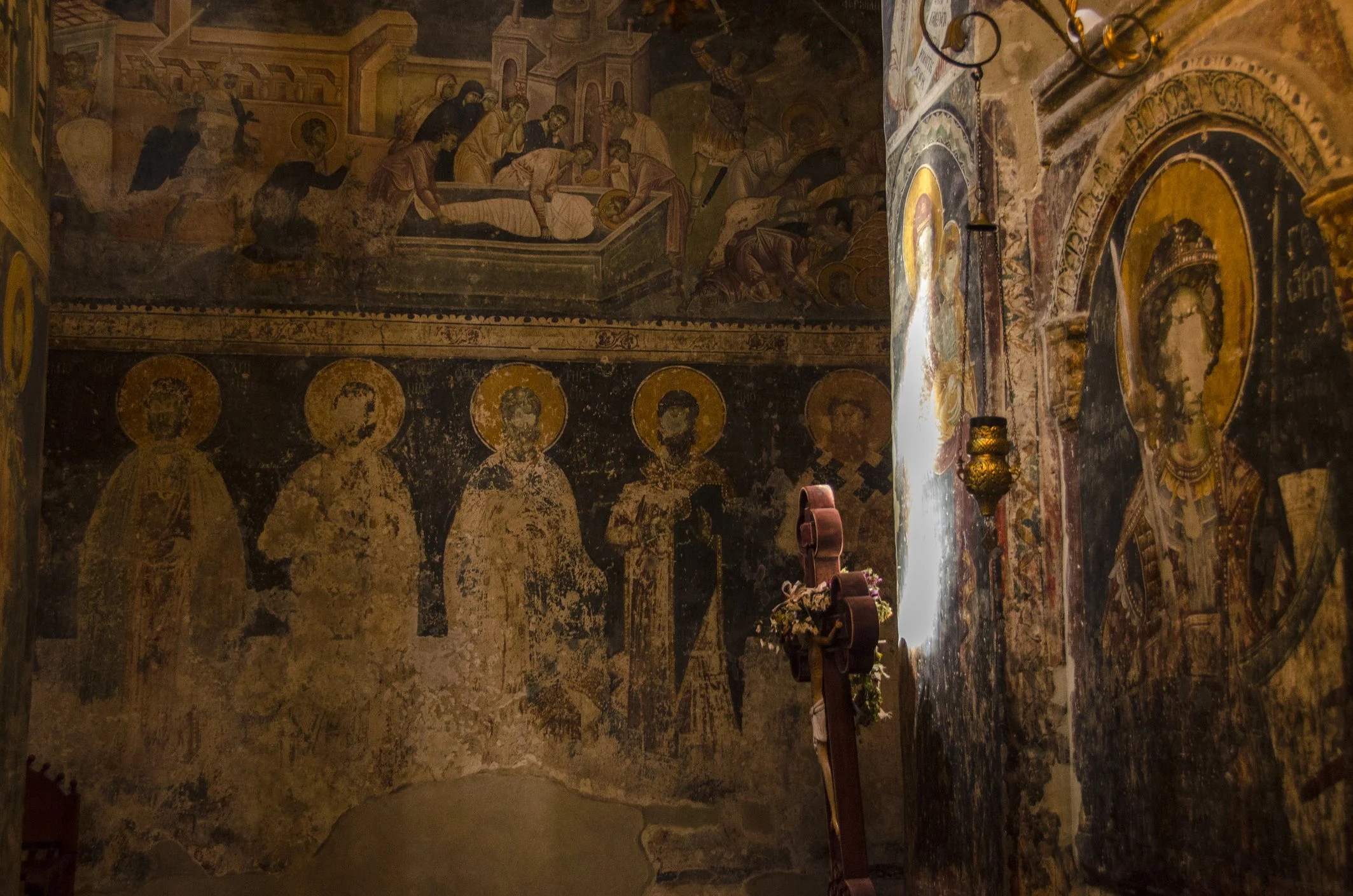
Frescoes in Staro Nagoričane, Macedonia
Demanding an explanation is why so few of the monuments of the Byzantine renaissance can be found in modern Istanbul itself: Constantinople was, after all, the capital and yet all the monuments described above lie scattered across the Balkans. The answer returns us to one of the tragic moments of Byzantine history: the sack of Constantinople by the Crusaders in 1204. With the looting of the “Ruling City” and the installation of a Frankish-Latin administration uninterested in the patronage of the arts, the first phase of the Byzantine renaissance was cut short in the city – the centre of the Eastern Christian world – that was likely its birthplace. What we see today, then, is the legacy of the dispersion of Byzantine masters from Constantinople across the medieval Balkans, where in the medieval kingdoms of Serbia and Bulgaria they found patrons and willing students. (The only part of the former Byzantine empire itself where contemporaneous monuments equal to the ones described above can be found is modern Trabzon in what is now Turkey, where, on the far-eastern shore of the Black Sea a fragment of the old empire in exile clung on unconquered by the Latins.)
Latin-Frankish rule eventually crumbled. In 1261, the rulers of another unconquered fragment of the old empire retook Constantinople, inaugurating the final, often politically extremely complicated, phase in Byzantium’s long history. Far from representing a period of stagnation, however, the slightly less than two centuries between the restoration of the empire and its definitive termination by the Turks was perhaps its most vibrant, intellectually, spiritually, and artistically. In Constantinople and beyond, the works of Plato, Aristotle and Plotinus were once again read and debated; on Mt Athos, a new spirituality – hesychasm – reinvigorated the interior life of Byzantium’s monasteries; and with the return of wealthy patrons to Constantinople, Thessaloniki and elsewhere, artistic production revived. As already noted, the best-known achievement artistically of this final phase of Byzantine civilisation (often called the “Palaiologan renaissance” after the ruling dynasty) is the spectacular frescoes and mosaics of Istanbul’s Chora Monastery.
What the legacy of the Byzantine, Serbian and Bulgarian masters in the Balkans helps us see, however, is the continuous tradition out of which the Chora emerged as the crowing, but far from isolated example. At the Church of St Mary Perivleptos (1295), for instance, in Ohrid, the masters responsible for the Betrayal of Christ by Judas Iscariot would anticipate Giotto’s rendering of the same scene in the solidity of the bodies of their subjects as well as the dramatic sense of movement that characterizes the whole.
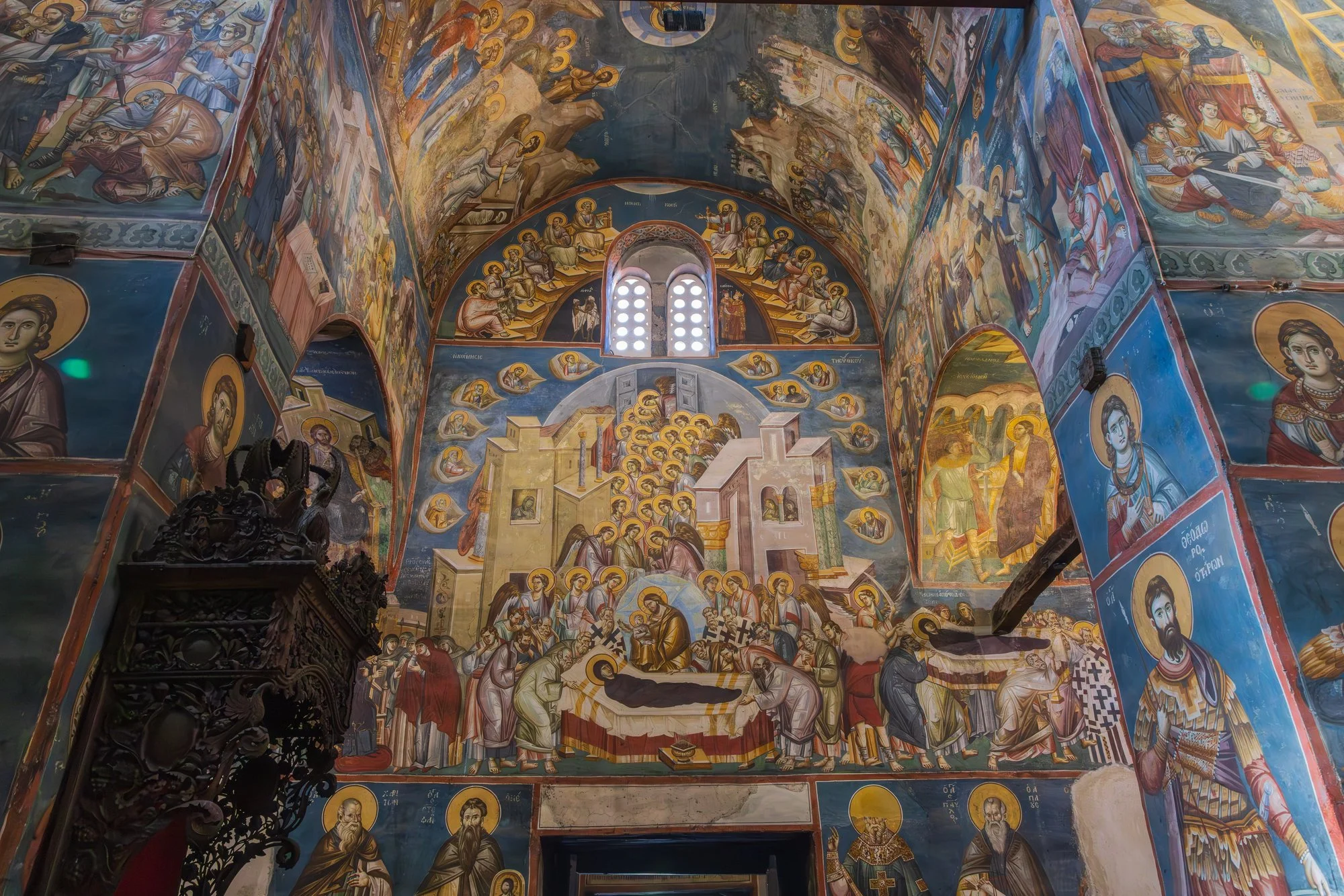
Murals in the Church of the Virgin Mary Peribleptos, a Byzantine Orthodox Church in Ohrid
Meanwhile, their rendering of the Dormition of the Virgin refutes any notion that – a century before Masaccio – the Byzantines were unaware of the principles of perspective. (What they simply refused to do was to orient their works around a vanishing horizon: in Byzantine art, the horizon is always the viewer him - or herself – in front of the image.)
At that time, Ohrid – a beautiful town sometimes dubbed the “inland Dubrovnik” for its picturesque setting on the shore of Europe’s deepest freshwater lake, elegant churches, and medieval streetscape – was ruled by the Serbs. But in the modern Greek city of Thessaloniki, which was still ruled directly from Constantinople, we see the final stage of the Byzantine renaissance on Byzantine territory proper. As far as painting is concerned, the most important monument here is the Churches of St Nikolaos Orphanos (1310-20), where, because uniquely in Thessaloniki it was never converted into a mosque, the church’s original early fourteenth-century cycle of frescoes remains intact. Again, it was discovered for the world of art only 1959, when six centuries of accumulated soot was cleaned from the frescoes’ surface.
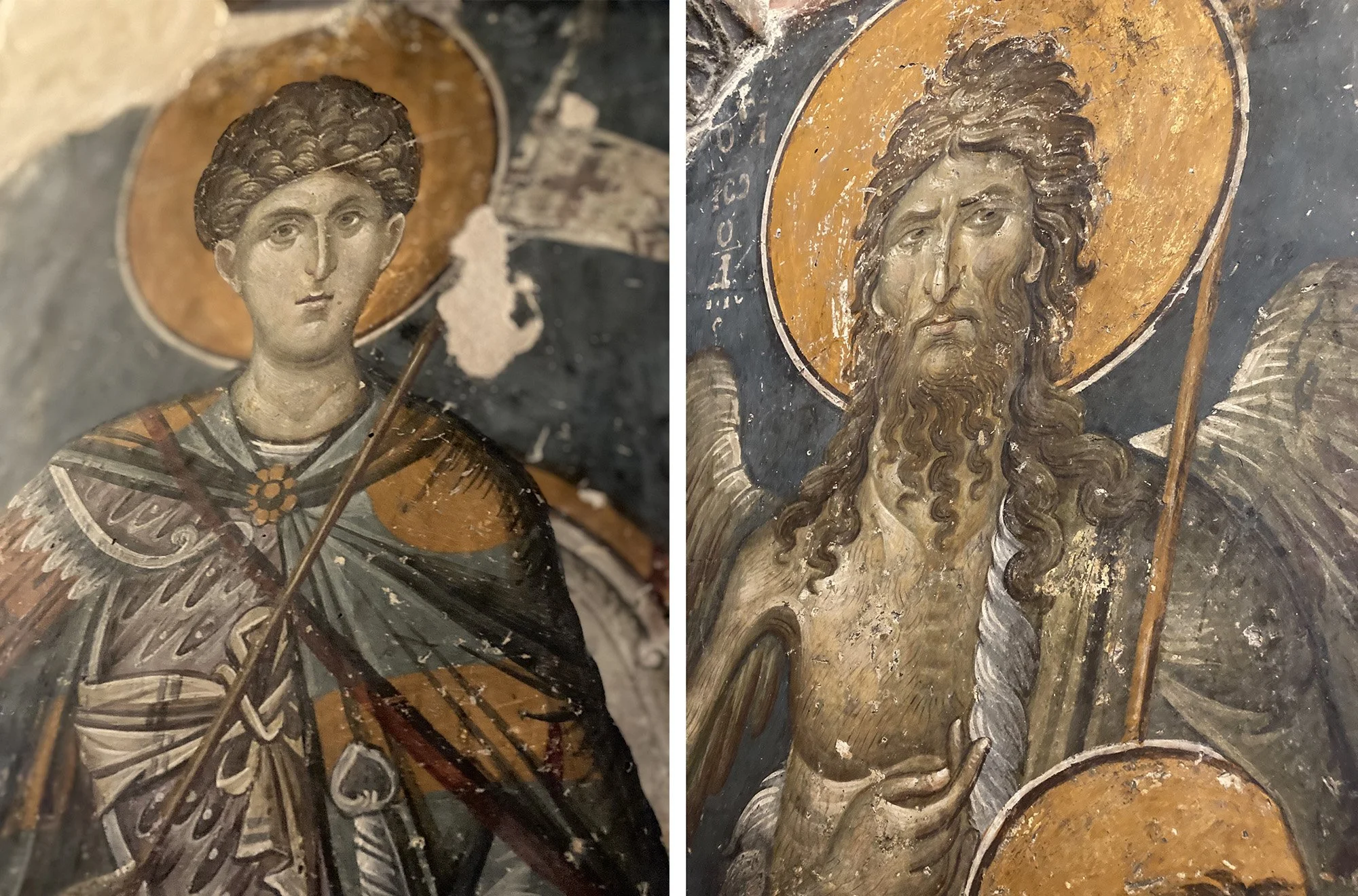
Fresco of St Demetrius and of St John the Baptist at the Churches of St Nikolaos Orphanos, Thessaloniki
What we see clearly at St Nikolaos Orphanos is that in addition to the interest in volume, movement and emotion, a distinguishing feature of the evolution of artistic style during this last period of the Byzantine renaissance is the sudden appearance of interest in the individual. To be sure, Byzantine art had never depicted the saints as mere types; the icon of each was always marked by the subject’s particular individuating marks or features. But these features were often symbolic while the underlying human figure remained basically the same. In later Byzantine painting, by contrast, the human figure acquires increasingly individual bodily features and the often breathtakingly naturalistic rendering of the eyes hints strongly at the presence of an individual interior spiritual life. This interest in individuality and interiority is manifest in the frescoes of St Nikolaos. Painted at eye level, the eyes of the soldier-saint Demetrius – Thessaloniki’s beloved patron – seem to meet the viewer’s own from off the wall, as do those of St John the Baptist and Christ himself further along.
But if there is, as I have claimed, a particular Byzantine “vision” of the human being and his or her spiritual calling, what is it? The answer, I think, lies in the intersection of the intellectual, spiritual and artistic movements described above. One thing that marks the art of the Byzantine renaissance is the almost kaleidoscopic use of colour; some commentators connect this to the revival of Neoplatonism. If light itself is a sign of the divinity, then colour, properly understood, is to light what the many are to the One: participations in, and manifestations of, its all-sustaining providence. That may be. But more profound, and more secure, it seems to me, are the connections between the renewed Byzantine interest in volume, movement, emotion in painting and the individuality and interiority that lay at the heart of the hesychastic movement that swept Byzantium’s monasteries.
Hesychasm – the pursuit of personal union with God through an intense regime of prayer “from the heart” culminating in a personal vision of the Uncreated Light – focused the attention of the late Byzantine Christian both on the individual and on the emotions, not as an end in themselves, but as integral elements of the passionate part of the soul that had to be purified and redirected, but not suppressed, on the soul’s ascent to union with God. And although the method of hesychasm – the unceasing repetition of the Jesus Prayer – only appeared in the thirteenth century, it was assimilated so readily because its spirit resonated with the orientation Byzantine piety had taken since the earliest days of the Byzantine renaissance itself: centuries before, the controversial Byzantine monk later memorialized as St Symeon the New Theologian (949-1022) awakened the latent emotional resources of Byzantine piety by calling for a re-interiorization of the Christian Gospel.
If attendance at liturgies, fasting, and obedience to the canons are not accompanied by a subjective and interior encounter with Christ in the Holy Spirit, flooding one’s soul with a practical love for one’s fellow man and the supernatural Light that was the sign of the direct presence of God, then they are nothing worth. Merely external and ritual religion was not enough; the hand of God had to touch the individual human heart. And isn’t this what we see in Our Lady of Vladimir, the St Panteleimon Lamentation and Sopoćani’s Dormition of the Virgin?
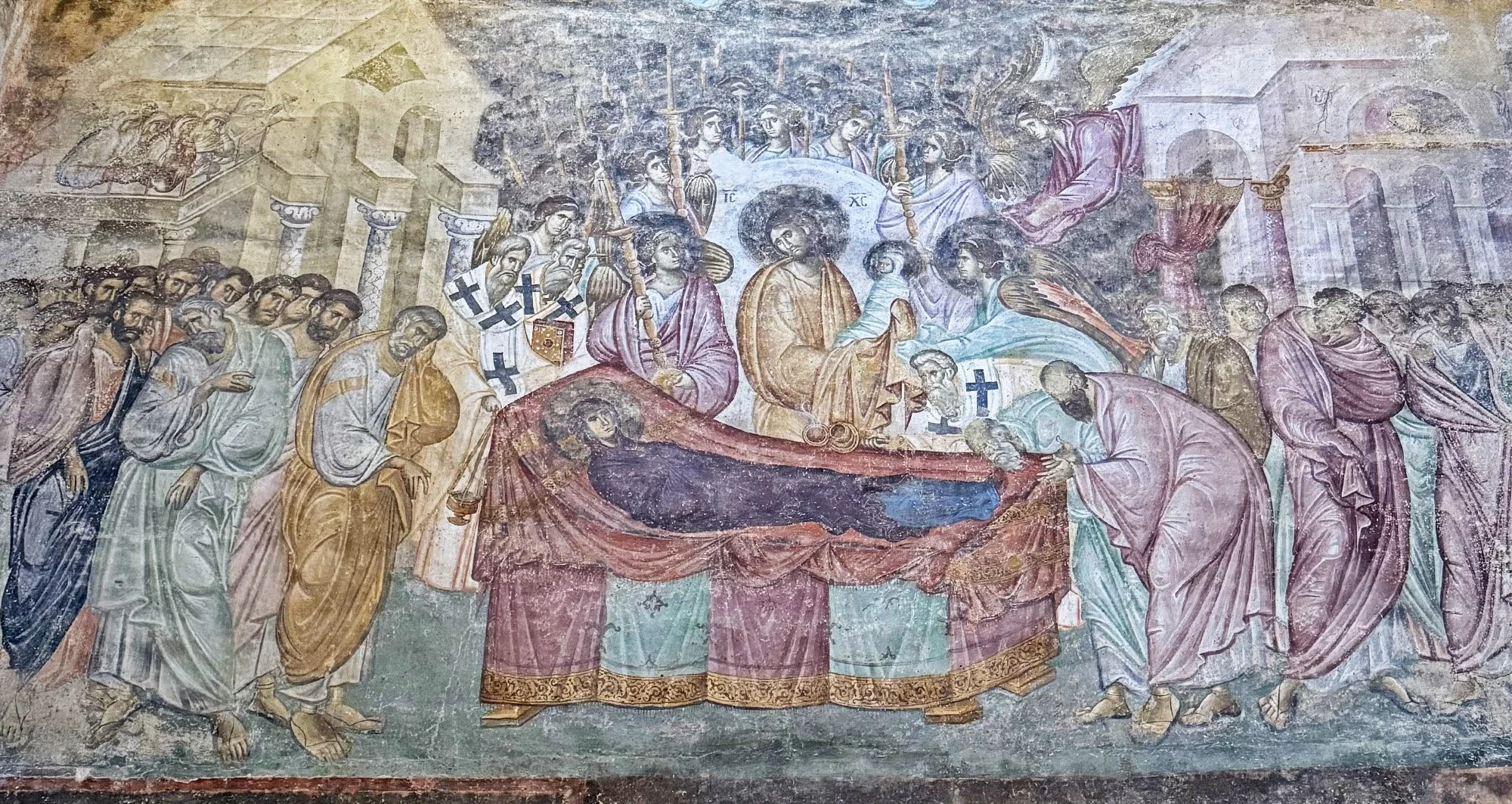
Sopoćani’s Dormition of the Virgin
In short, then, if there is a specifically “Byzantine” vision of the human condition it is that human nature never constitutes a “closed” or self-contained system; the human being, and indeed, the natural world itself, always open, as it were “naturally”, onto God. This is visible in perhaps the most significant difference between Italian and late Byzantine painting, namely, that the human figure never attained in the latter what has been described as the almost “sculptural solidity” – the rounded corporality, the sheer, “realistic” fleshy-ness – which it acquired in the West during the Italian Renaissance and which is visible already in Giotto: between Giotto and the fully enfleshed figures of Michelangelo, there is a difference in degree but not in fundamental outlook. In this sense, Byzantine painting never achieved the “realism” of Italian. But then again, the very Byzantine view of “reality” was different.
Whereas in Western Europe the rediscovery of volume, movement and emotion were taken as announcing the dignity – and even, perhaps, the self-contained autonomy – of nature on its own terms, in the Christian East, nature never lost its intrinsic openness to spirit. In Giotto’s frescoes the third dimension is so heavily emphasized that it ends up enclosing the spirit in the body: at this point, Giotto’s rendering of human emotion becomes the illustration of a purely human psychological state rather than the beginning of spirit’s stirring towards God; in the same way, movement (of the soul upwards to God) becomes merely this-worldly commotion, (“horizontal”) bustle. In what survives of late Byzantine painting, by contrast, the revival of naturalism in art never means the representation of a merely “imminent” human or natural reality apart from the presence always immediately within, behind and beyond it of what St Gregory Palamas (1296-1368), the most important late Byzantine theologian, called the “uncreated energies” of God, the world’s transcendent Logos and Creator. As he put it in a homily on the Transfiguration, “The King of all is everywhere, and so is His kingdom, so the coming of His kingdom does not mean it arrives here from somewhere else, but that it is revealed through the power of the divine Spirit.” That the permanent horizon of the world is God, who summons humankind to unending communion in his life and glory, is the vision that all late Byzantine painting essentially transmits.
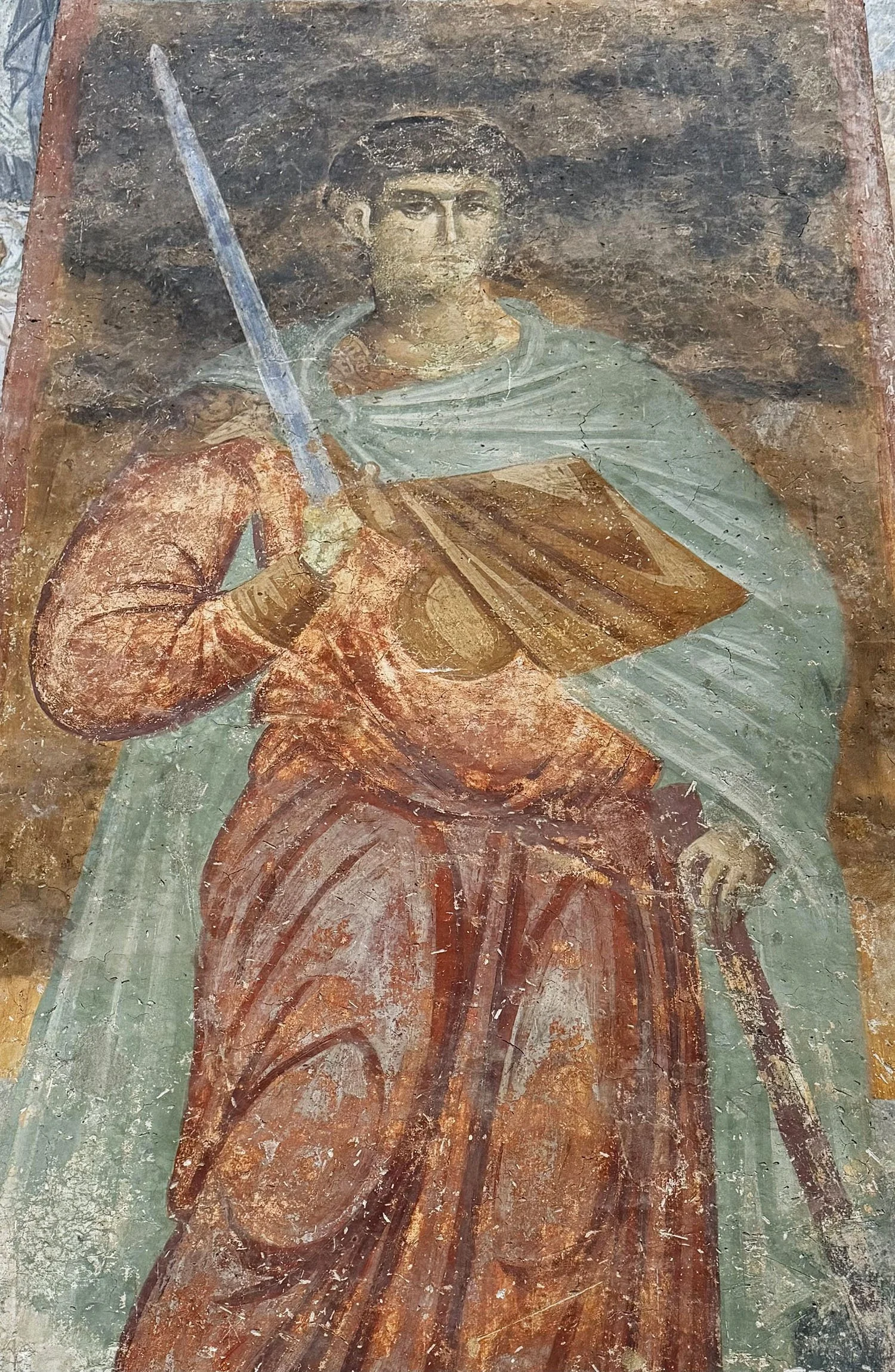
In the end, then, the difference between the (always ultimately translucent) human figure of late Byzantine painting and the (rounded and solidly fleshly) human figures of Giotto and the subsequent Italian Renaissance is not one of skill but of mentalité, outlook. To grasp this more concretely, we may compare Giotto’s putti (or even Fra’ Angelico’s Gabriel a century later) to the master of Sopoćani’s St Michael the Archangel. Whereas for the Italians, the angels, who are by nature pure spirit, can be represented with the same solid corporeality as material human nature, for the Byzantine master, the human form the angel has assumed only announces to “natural”, material man his true calling to “become God” (that is, spirit) without ceasing to be human – and therefore to assume his place at the centre of the cosmos as that being who is both matter (body) and spirit at the same time.
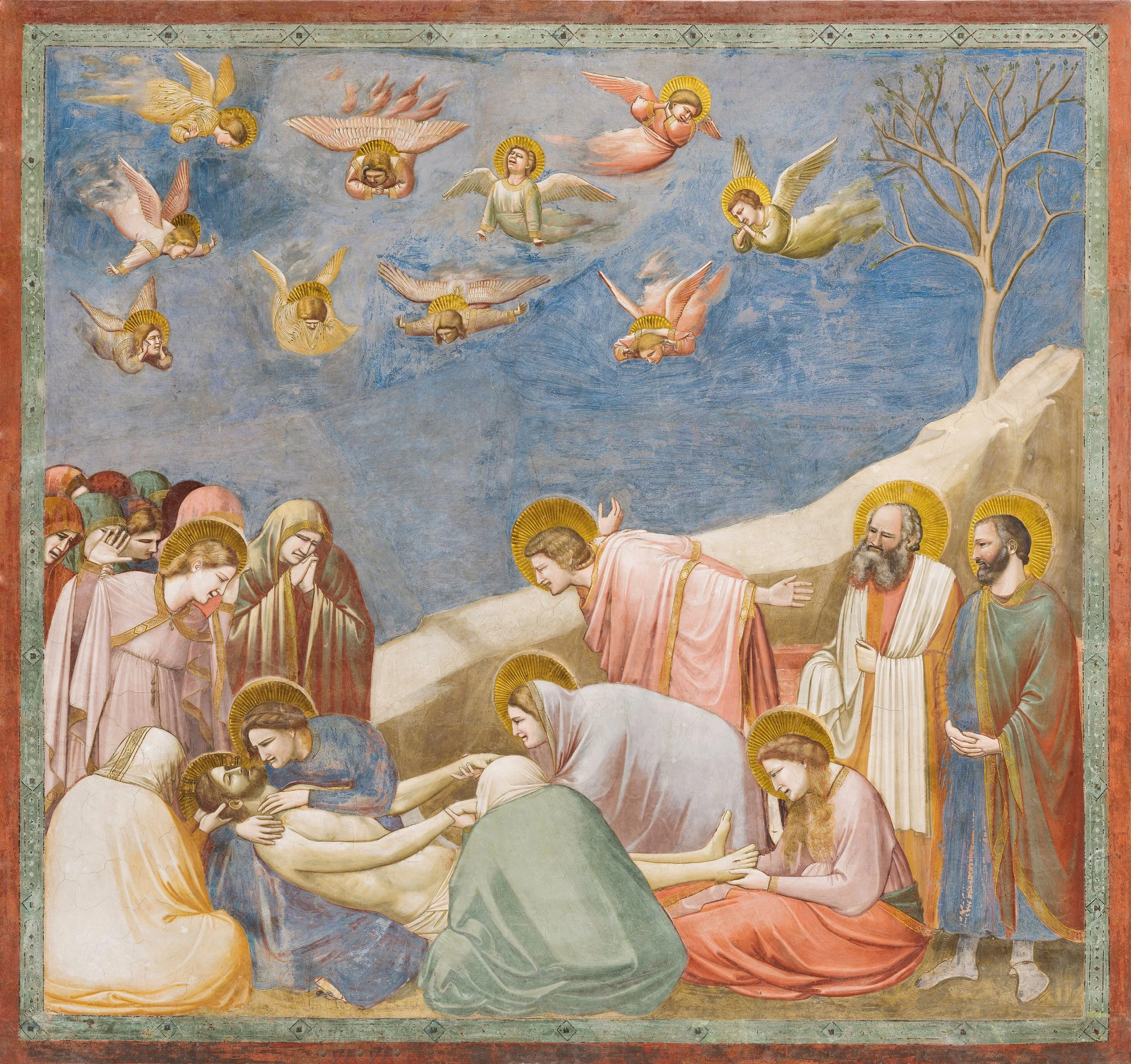
Image putti in Giotto’s The Lamentation of Christ, c.1305
And yet the message of late Byzantine art is also that this “divine horizon” of every human person is no threat either to the mystery of human individuality or to the unique movements of every human heart. On the contrary, the divine life to which human nature is called cannot be attained without them.
TOUR THE BALKANS
With Dr Matthew Dal Santo
Journeying from Thessaloniki to Belgrade across 18-days, explore the cultural crossroads of the Balkans, where centuries of shifting empires have shaped this diverse region.
Limited Places Remain
Further Reading
André Grabar, The Art of the Byzantine Empire (New York, 1963)
David Talbot Rice, The Art of the Byzantine Era (New York, 1963)
Gervase Mathew, Byzantine Aesthetics (New York, 1964)
Kurt Weitzman et al., Icônes: Grèce, Bulgarie, Yougoslavie (Belgrade, 1966)
Viktor Lazarev, Storia della pittura bizantina (1967)
David Talbot Rice, Byzantine Painting: The last phase (New York, 1968)
Sir Steven Runicman, The Last Byzantine Renaissance (Cambridge, 1970)
Sir Steven Runciman, Byzantine Style and Civilization (London, 1975; repr. 1990)
Tania Velmans, La Peinture murale byzantine à la fin du Moyen Âge (Paris, 1977)
A. P. Kazhdan and Ann Wharton Epstein, Change in Byzantine Culture in the Eleventh and Twelfth Centuries (Berkeley, 1985)
Robin Cormack, Writing in Gold: Byzantine Society and its icons (London: George Philip, 1985)
Robin Cormack, Byzantine Art, 2nd ed. (Oxford: Oxford University Press, 2008)
Sarah T. Brooks, ed., Byzantium: Faith and power (1261-1557), Metropolitan Museum of Art Symposia (New York, 2006)
Ellen C. Schwartz, The Oxford Handbook of Byzantine Art and Architecture (Oxford: 2021)