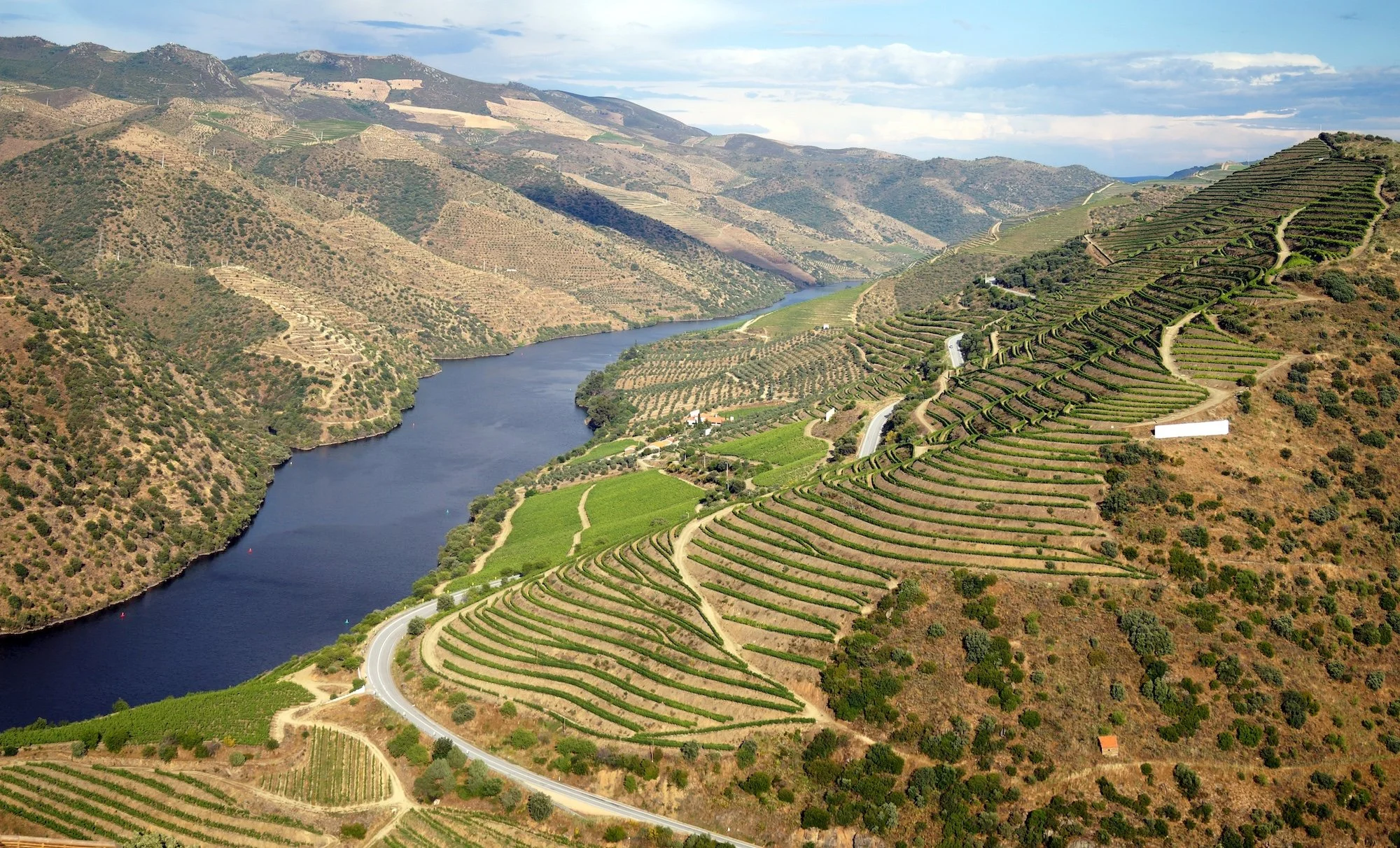
Côa Valley
Portugal is a small nation, but geologically, historically and artistically complex.
It is often introduced through its medieval kingdoms and Atlantic expansion, yet these chapters represent only a late moment in a far longer story.
Long before Lisbon became a capital or Porto a mercantile hub, the landscapes of western Iberia were shaped by deep time, prehistoric ritual, Roman urbanism and medieval monastic reform. Many of the most revealing sites from these periods lie away from Portugal’s busiest centres – embedded in rural plains, concealed beneath later cities or perched dramatically along the Atlantic coast.
Taken together, these places reveal how successive societies understood landscape, power, belief and daily life across millennia. They show continuity as much as change, and they offer a way of reading Portugal not as a sequence of disconnected eras, but as a landscape repeatedly reimagined and reused.
Before History – The Atlantic edge
Any serious engagement with Portugal’s past must begin before human history altogether. Along the limestone cliffs of the central Atlantic coast, geological processes have preserved evidence of life from an almost unimaginable timescale.
At Cabo Espichel dinosaur footprints, fossilised tracks dating to the Late Jurassic period – around 150 million years ago – record the movement of dinosaurs across a shallow coastal environment. The footprints, left by large theropods and sauropods, are preserved on steeply inclined rock faces, their unusual orientation the result of tectonic uplift long after the animals passed through.
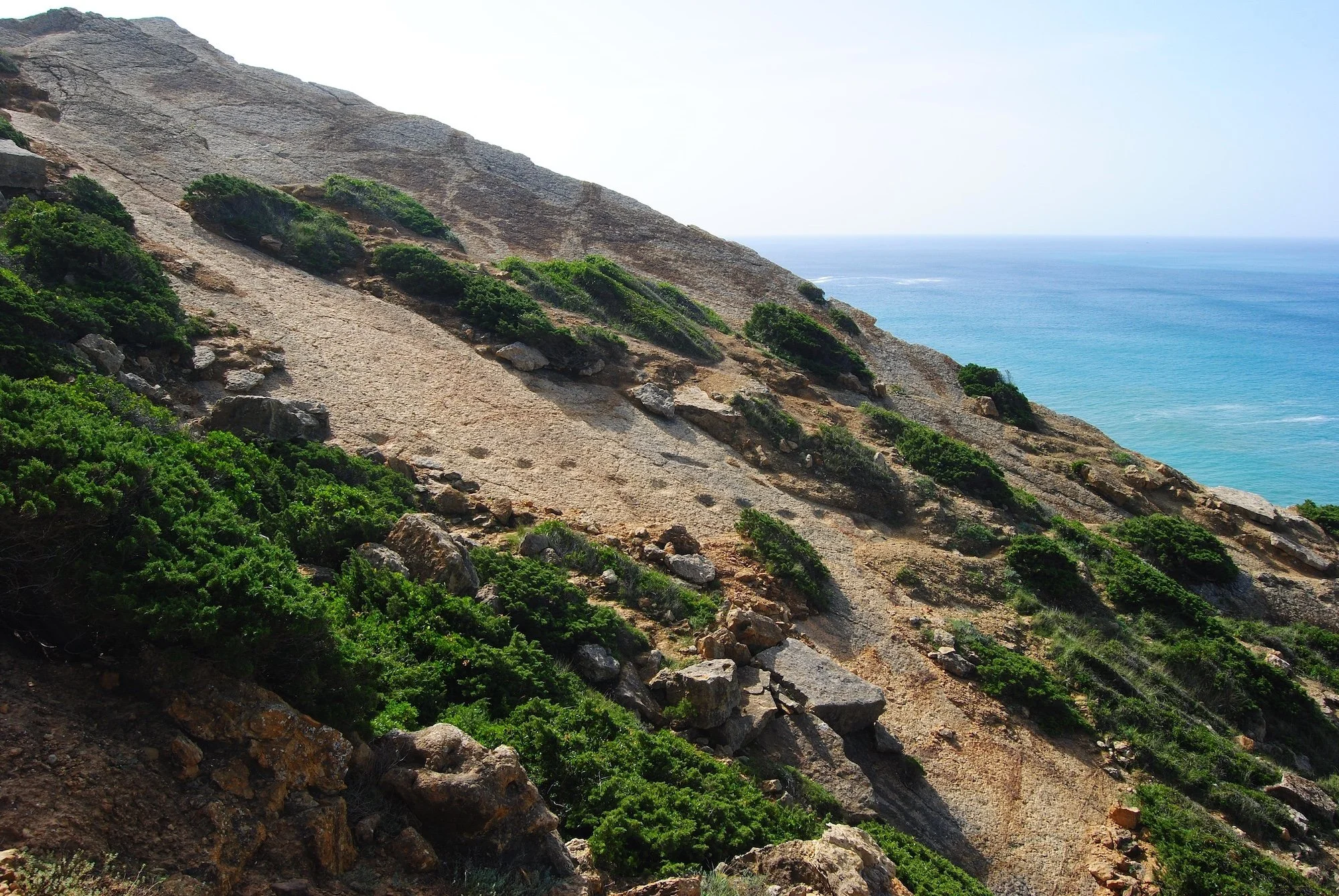
Dinosaur footprints on the limestone cliffs north of Cabo Espichel
From a scientific perspective, these tracks are invaluable. They provide insight into dinosaur locomotion, gait and group behaviour, captured in situ rather than reconstructed from skeletal remains. Yet their cultural afterlife is equally revealing. For centuries, local tradition interpreted the prints as the hoofmarks of a miraculous mule ridden by the Virgin Mary, believed to have ascended the cliffs to the sanctuary above. This legend shaped the establishment of the Sanctuary of Nossa Senhora do Cabo Espichel, transforming a palaeontological phenomenon into a site of pilgrimage.
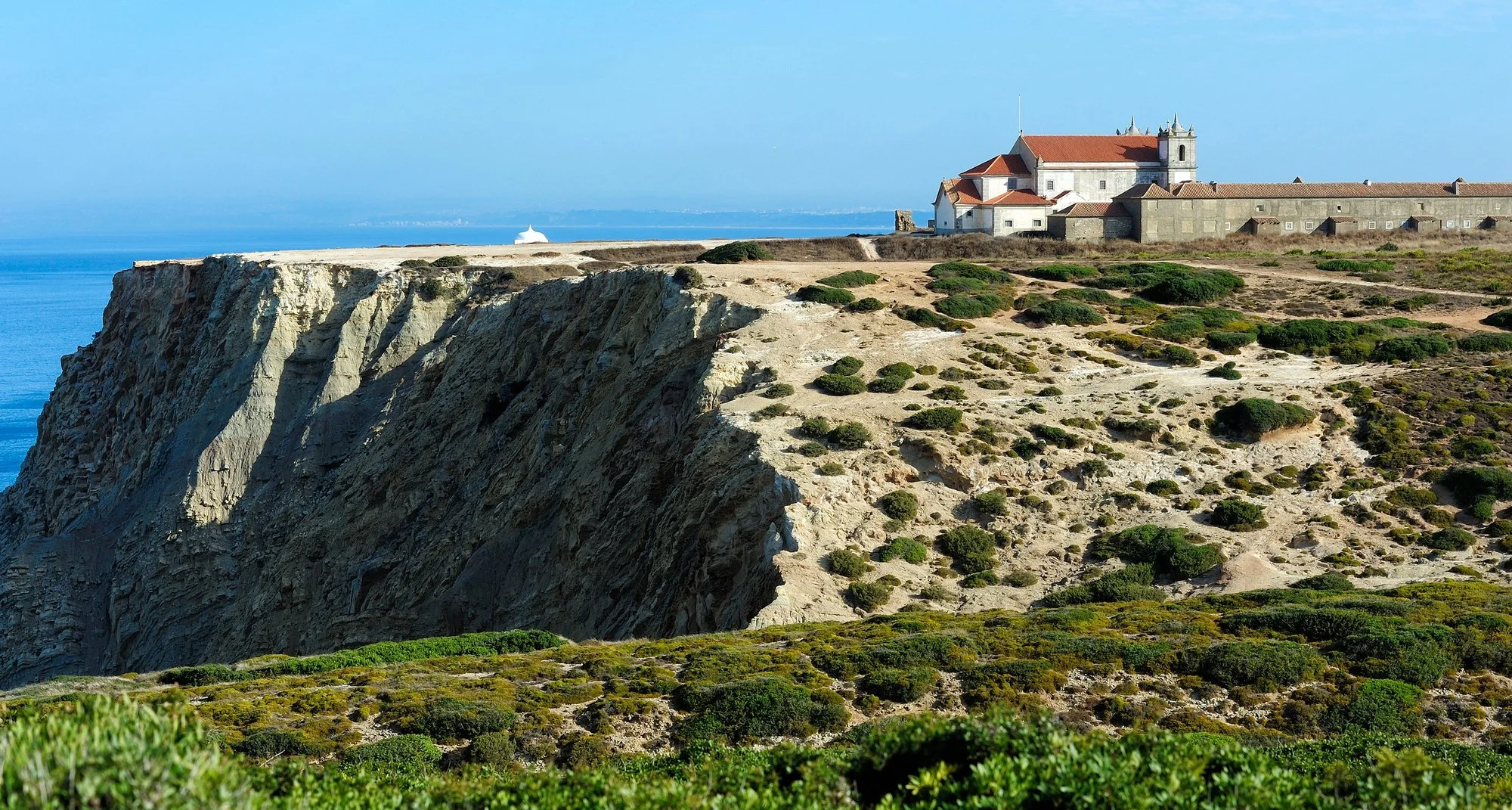
Sanctuary of Nossa Senhora do Cabo Espichel
Cabo Espichel therefore exemplifies a recurring pattern in Portugal’s past: the layering of meaning over time. Geological reality, medieval devotion and modern scientific interpretation coexist within a single landscape, each reframing what came before.
Monumental Memory – The Megalithic Alentejo
If Cabo Espichel situates Portugal within geological deep time, the megalithic monuments of the Alentejo, inland from Cabo Espichel, mark the beginning of human attempts to inscribe meaning permanently onto the land. This region preserves one of Europe’s densest concentrations of prehistoric monuments dating from the 5th to the 3rd millennia BCE.
The most imposing of these is the Anta do Zambujeiro, among the largest dolmens in the Iberian Peninsula. Constructed from enormous granite orthostats supporting a colossal capstone, the monument was originally enclosed beneath a substantial earthen mound, creating a structure that combined monumentality with ritual enclosure.
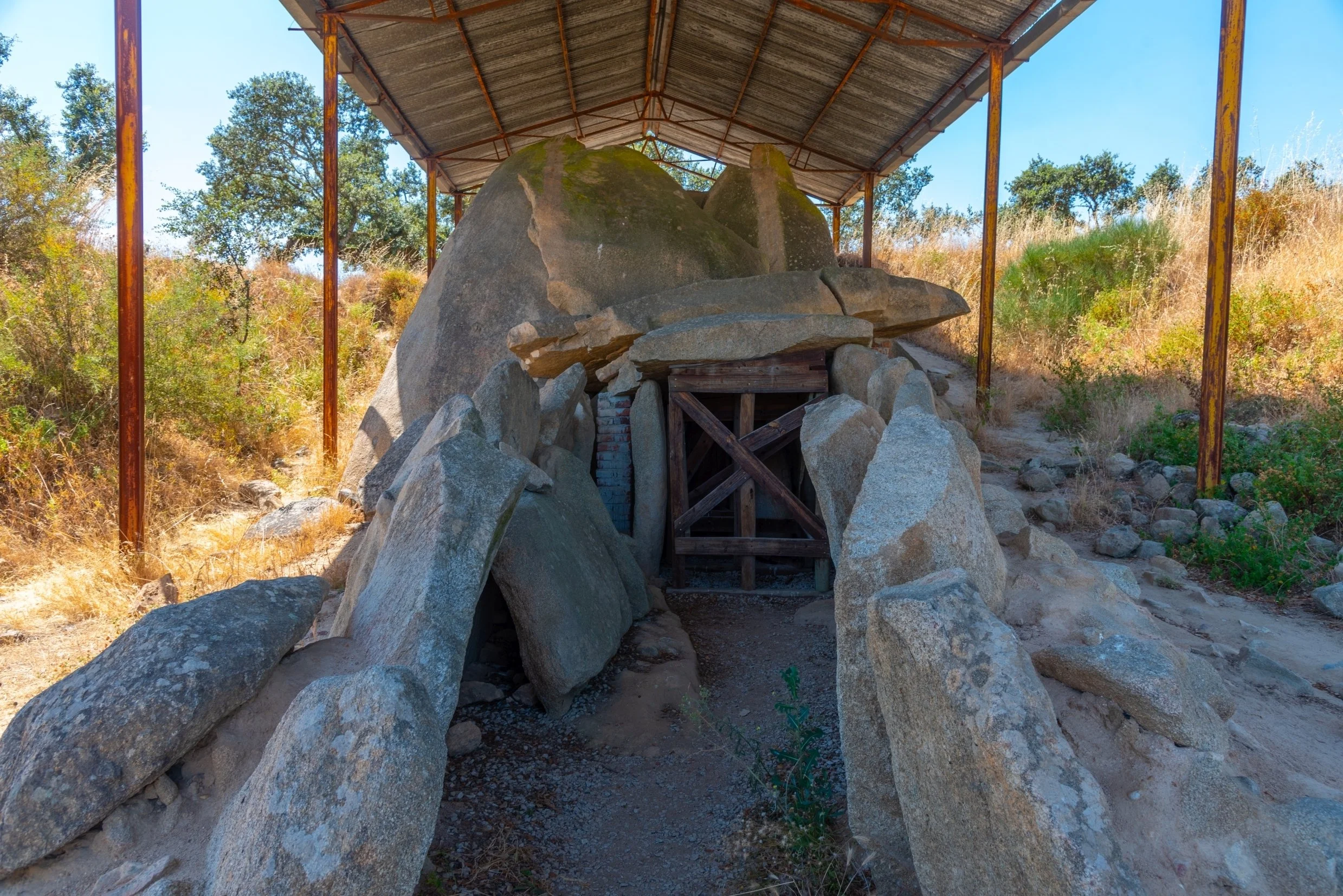
Anta do Zambujeiro
Archaeology shows that these monuments were not used just once and abandoned. Human remains and grave goods reveal that communities returned to them over generations, burying their dead together rather than individually. They were places of gathering and remembrance — not simply tombs, but long-standing centres of ritual and identity. Increasingly, researchers understand them as part of wider sacred landscapes, carefully positioned in relation to the sun, the horizon and the rhythms of seasonal life.
The sheer effort involved in raising stones of this size — quarrying, moving and setting blocks weighing many tonnes — speaks to organised communities with shared beliefs and a strong sense of purpose. These were people thinking beyond a single lifetime, building monuments meant to last and to anchor memory within the land. Crucially, these monuments did not disappear with later cultural transformations. They remained visible and influential features, shaping how subsequent communities understood territory, history and identity. In this sense, the megaliths of the Alentejo form the deepest cultural layer in Portugal’s long story.
Côa Valley – Palaeolithic voices in the landscape
Further evidence of Portugal’s prehistoric past can be seen in the Côa Valley Archaeological Park, which contains thousands of open-air engravings dating back to the end of the Palaeolithic era (c. 10,000–8,000 BCE).
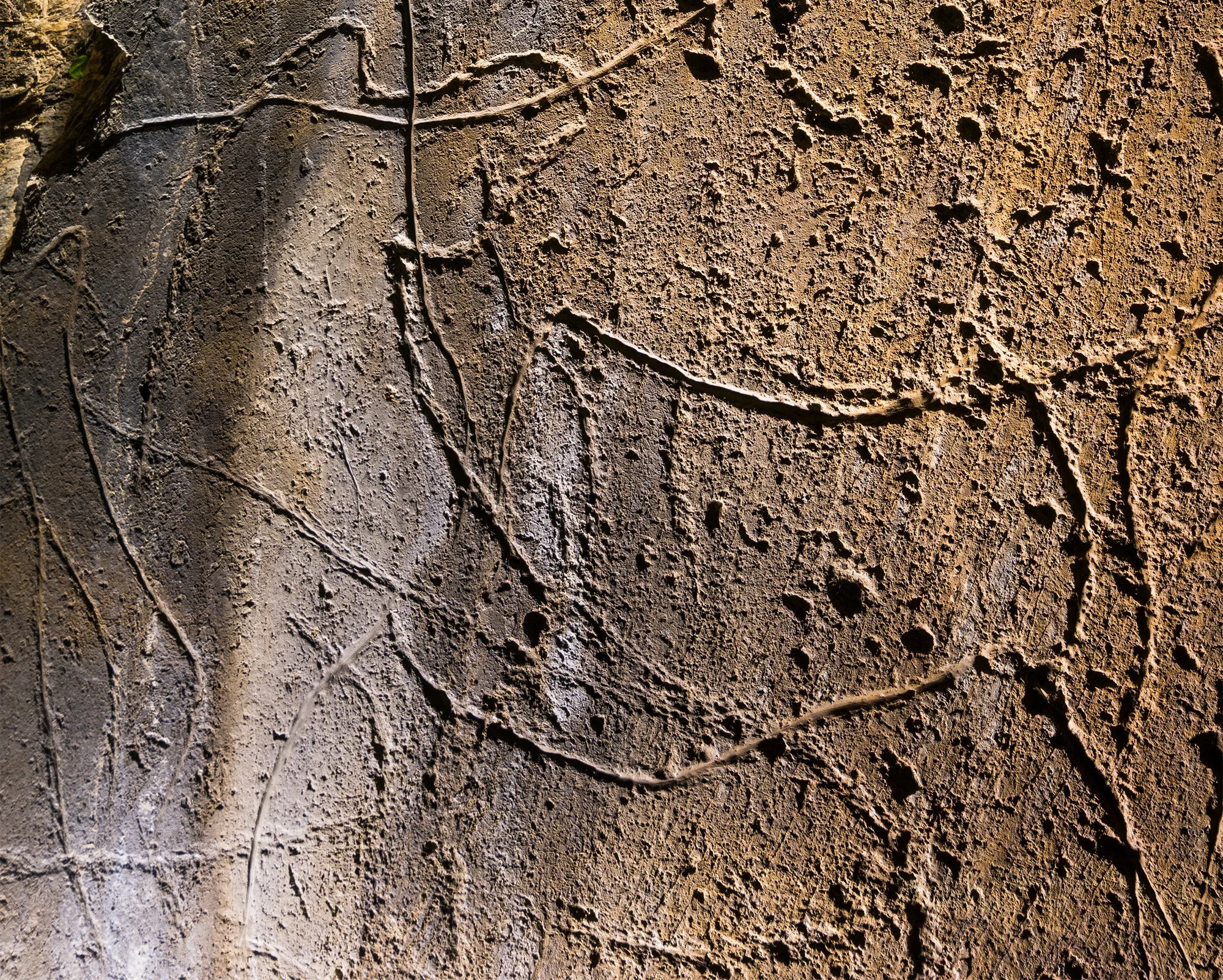
Engravings of Penascosa Archaeological Site within Côa Valley
Unlike rock art hidden inside caves, these engravings occupy sheer granite outcrops overlooking the Côa River. One of the largest concentrations of prehistoric rock art in the world, they capture humans in motion: horsemen, aurochs, ibex and geometric forms etched into stone by people whose world was shaped by ice-age climates, mobile lifeways and intimate knowledge of landscape. Their scale and visibility suggest that these were not private works, but shared markers — perhaps connected to seasonal migration, shared ritual or belonging to a place.
An outstanding Museum dedicated to the interpretation of these findings can be visited in the nearby in the small inland town of Vila de Foz Côa (pictured below).
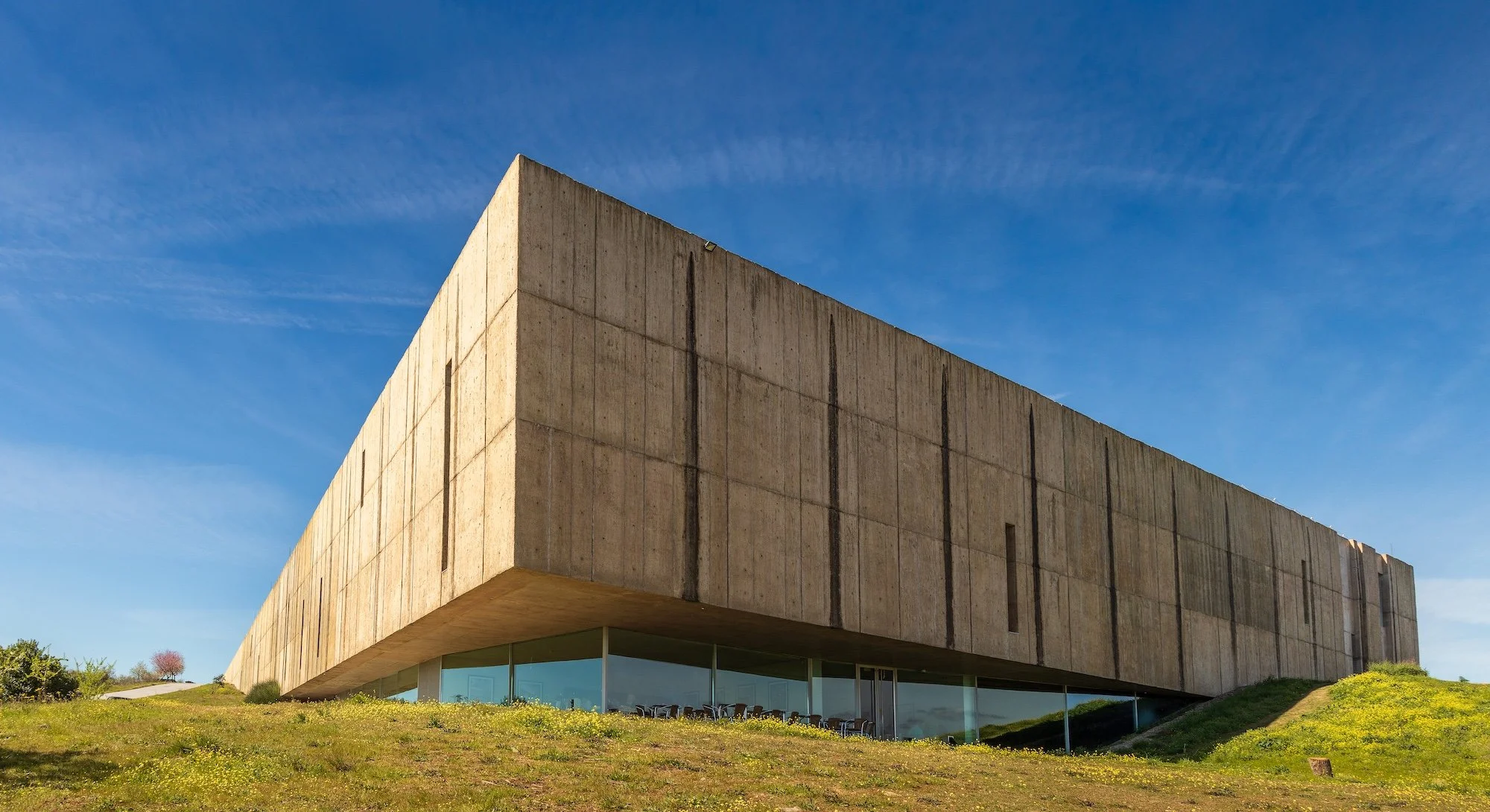
Vila Nova de Foz Coa, Portugal
Rome in Lusitania – Ordering Ancient Landscapes
Roman expansion into western Iberia in the late 1st century BCE introduced new political and economic systems, but it did not overwrite earlier structures. Instead, Roman administration reorganised existing landscapes, binding them into imperial networks through roads, cities and agricultural estates.
At Évora, Roman authority is most clearly expressed in the city’s temple, traditionally – and misleadingly – associated with Diana. More convincingly interpreted as part of an imperial cult complex, the monument once dominated a forum that structured civic life. Its elevated podium and Corinthian columns articulated Roman ideals of order, hierarchy and legitimacy, projecting imperial presence at the western edge of the empire.
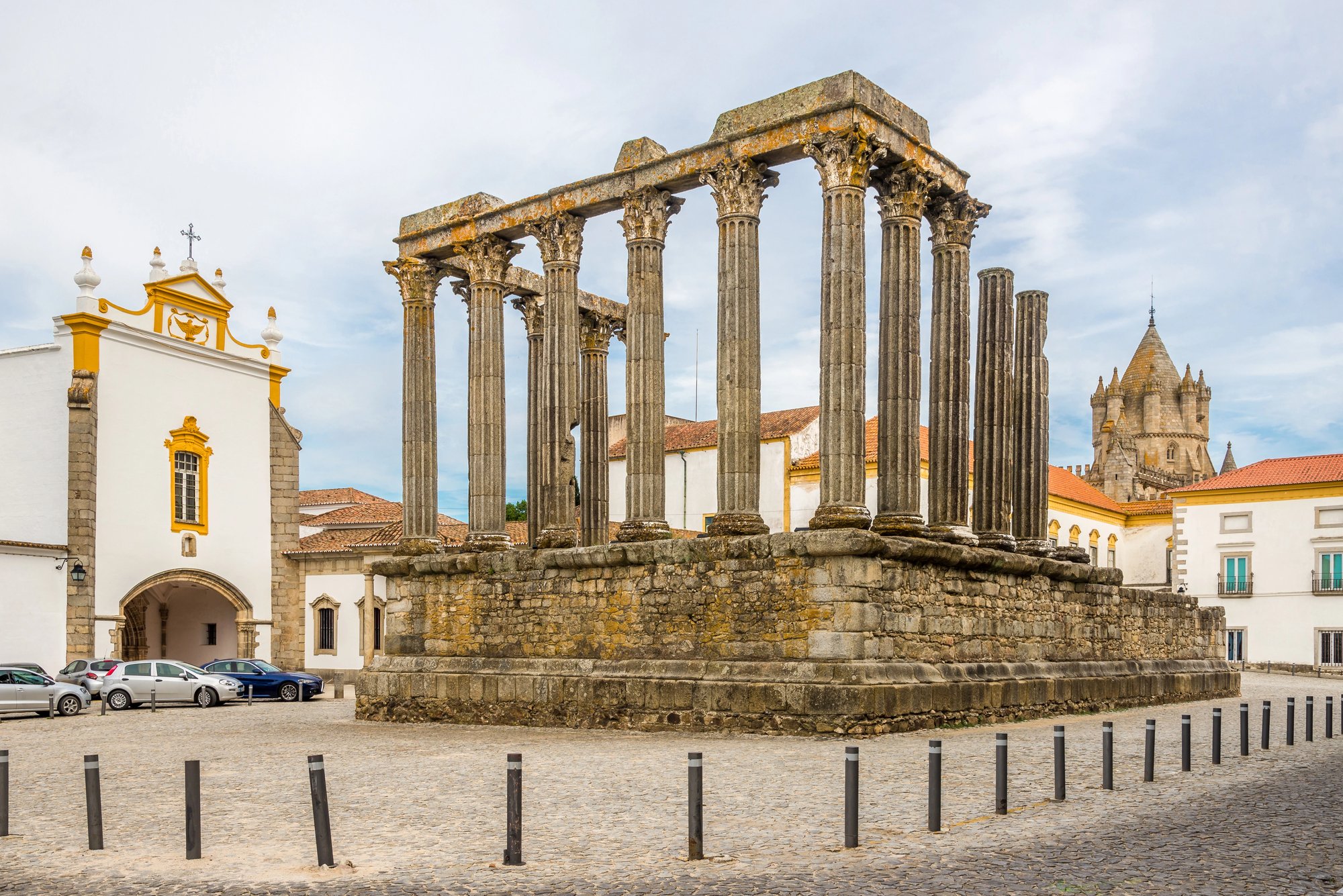
Ruins of Évora Temple
Évora’s importance lay not only in symbolism but in function. As a regional administrative centre, it coordinated agricultural production, taxation and legal processes across a wide hinterland. Roman urbanism here was both practical and ideological, integrating local elites into imperial systems and ensuring continuity long after direct Roman control faded.
That continuity remains legible today. Medieval walls, Gothic churches and later Renaissance buildings grew directly from the Roman urban footprint. Streets, reused stone and inherited sightlines reveal how Roman spatial logic shaped Évora well beyond antiquity.
Conímbriga – Roman life in detail
If Évora speaks of Roman authority and administration, Conímbriga reveals how that authority translated into everyday life. One of the largest Roman settlements in present-day Portugal, Conímbriga flourished from the 1st century BCE until the disruptions of late antiquity led to its gradual contraction.
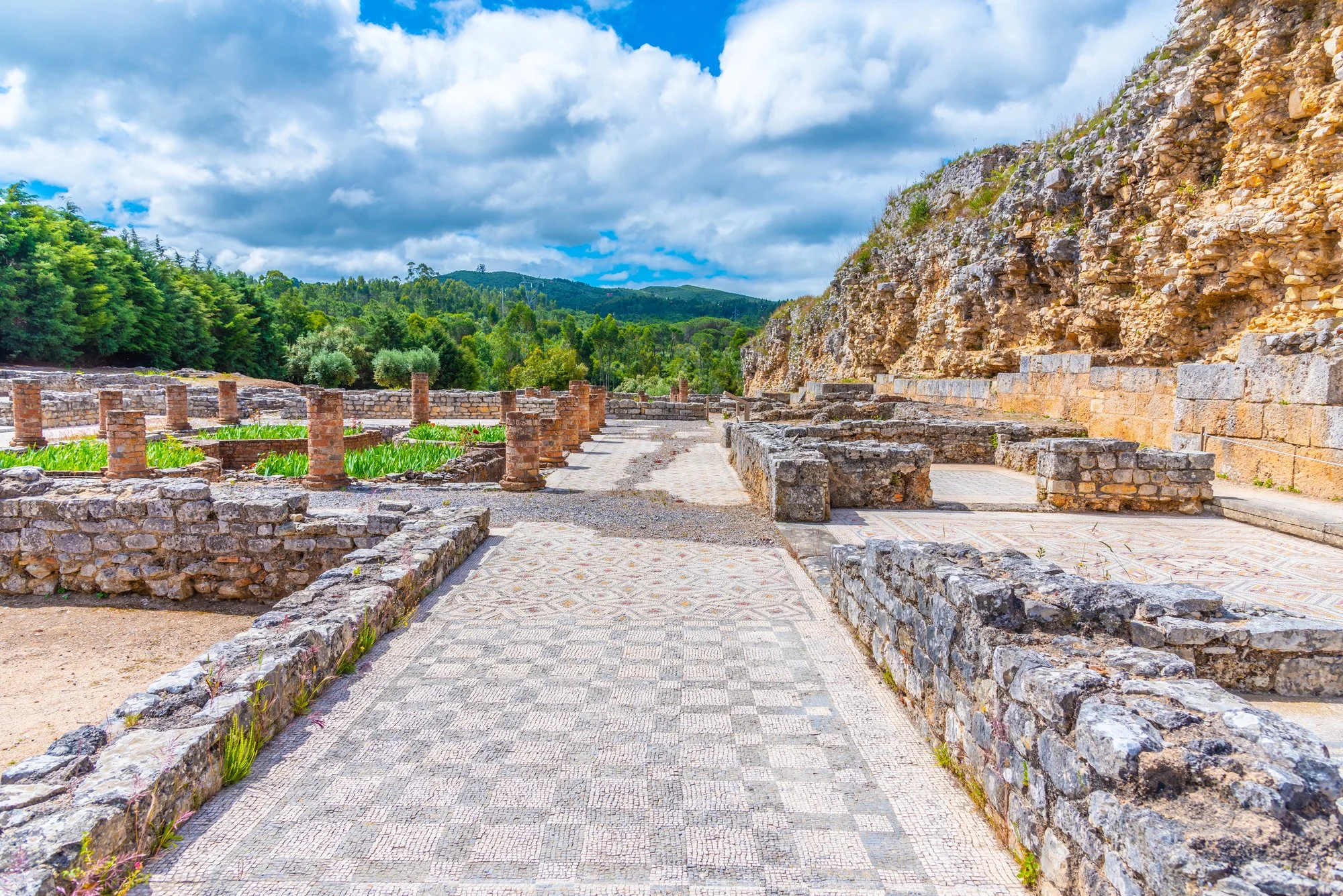
Conimbriga Roman Ruins
What makes the site so compelling is its intimacy. Residences such as the House of the Fountains (Casa dos Repuxos) display elegant courtyards and some of the finest mosaic pavements in the Roman West. Geometric designs and mythological scenes once lay beneath the feet of prosperous families, signalling education, refinement and participation in a shared Roman cultural world.
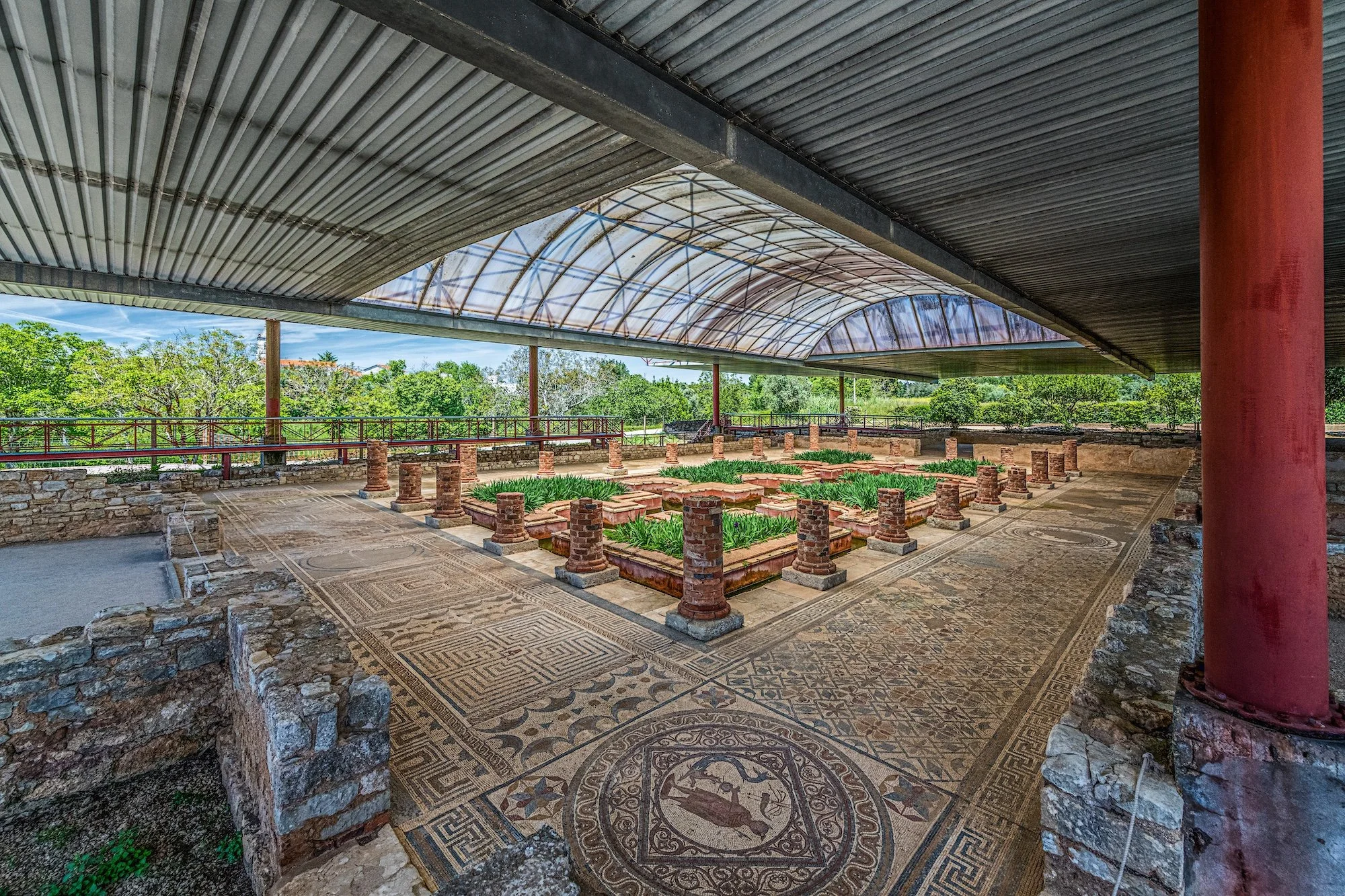
The Conímbriga Ruins are one of the largest Roman settlements ever excavated in Portugal
Yet Conímbriga’s prosperity depended on the surrounding countryside. Beyond the city walls, villa estates produced olive oil, wine and grain, forming the economic backbone of Lusitania. Presses and storage rooms stood alongside bath suites and reception spaces, combining productivity with comfort. Urban refinement and rural enterprise were inseparable.
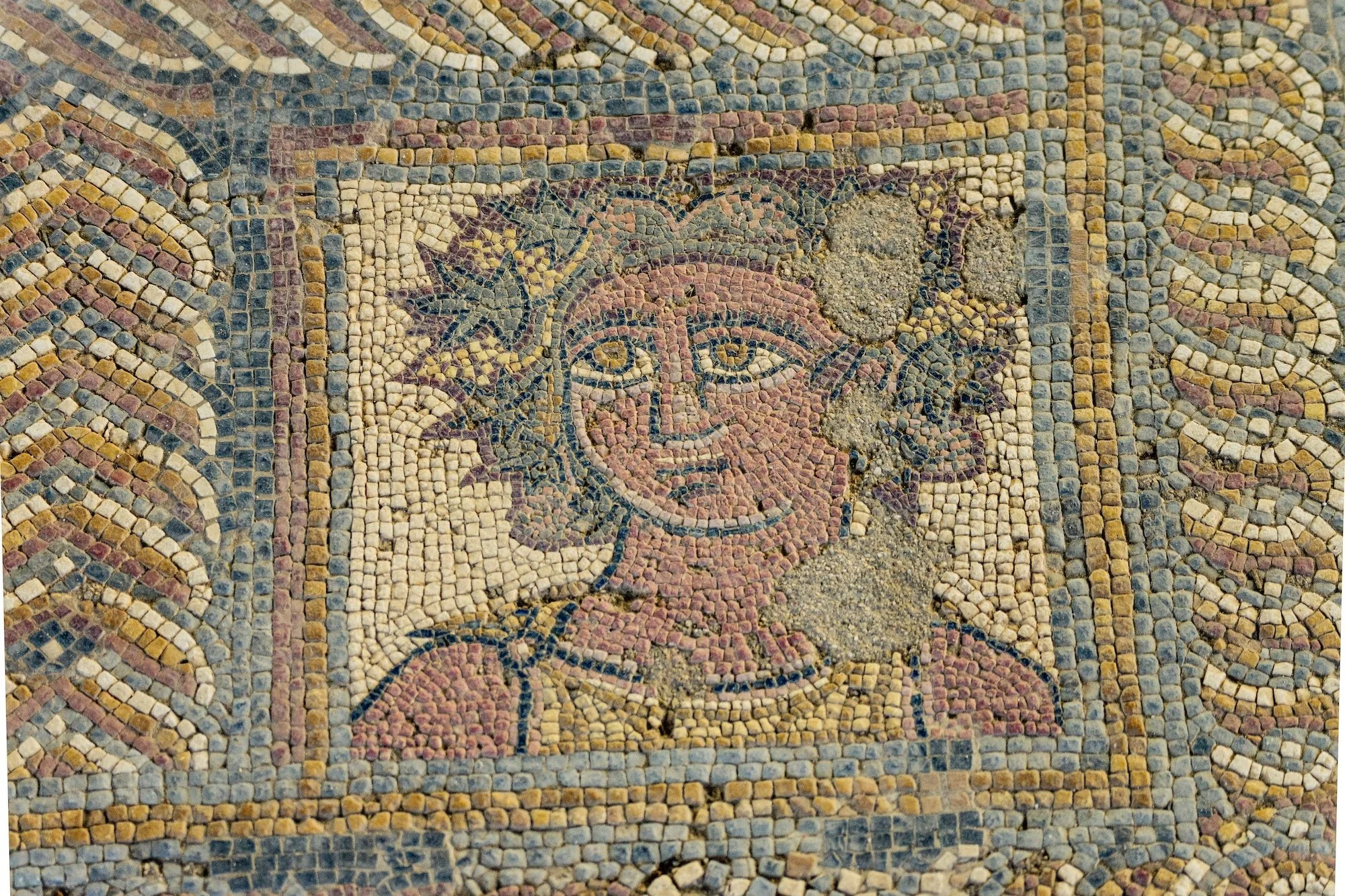
Female face in figurative mosaic, House of the Surtidores, Conímbriga
Public infrastructure further reflects Roman priorities. Bath complexes emphasised sociability and civic identity; aqueducts and drainage systems demonstrate technical precision; later defensive walls reveal adaptation in uncertain times. At Conímbriga, Roman Portugal comes into focus not as distant empire, but as lived experience.
Coimbra – a Roman city beneath a medieval one
Modern Coimbra is defined by its hilltop university, yet beneath its streets lies the Roman city of Aeminium. One of its most remarkable survivals is the Roman cryptoporticus, a vast subterranean complex of vaulted corridors constructed to support the forum above.
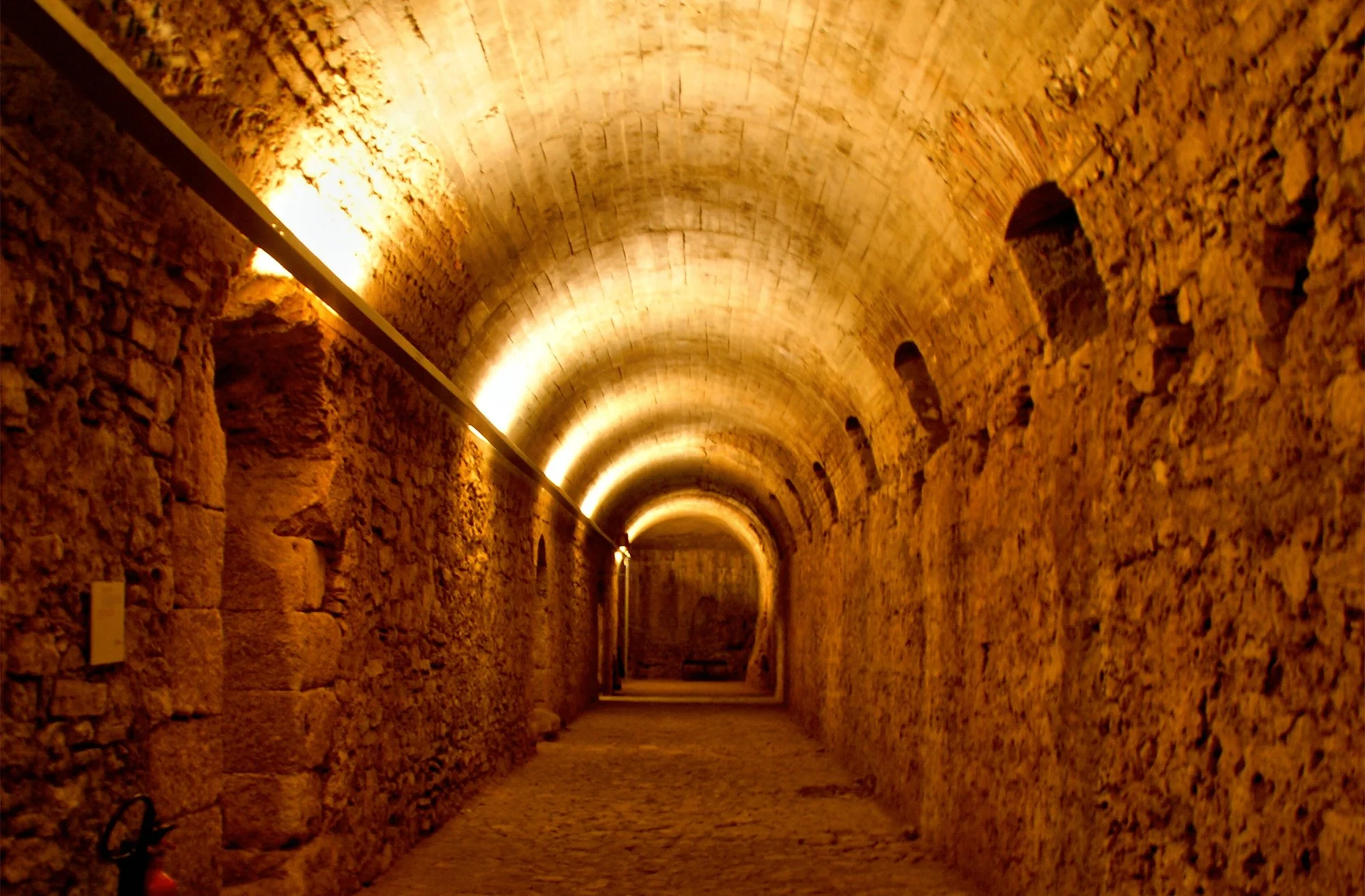
A true city underneath the city - Coimbra Roman Cryptoporticus
The Coimbra Roman Cryptoporticus exemplifies Roman ingenuity in adapting urban planning to challenging terrain. Rather than reshaping the hill itself, engineers created an artificial platform through layered substructures, maximising usable space while ensuring long-term stability.
These corridors also served practical functions, including storage and circulation, underscoring Rome’s emphasis on efficiency as well as monumentality. As Coimbra developed through medieval and early modern periods, Roman foundations became the literal base for later construction. The result is a city where history is layered vertically, with Roman, medieval and modern Coimbra occupying the same physical space.
Alcobaça – the reshaping of land
The medieval period did not sever these deep connections but reinterpreted them through new religious and political frameworks. One of the most significant expressions of this transformation is Alcobaça Monastery, founded in the 12th century by the Cistercian Order.
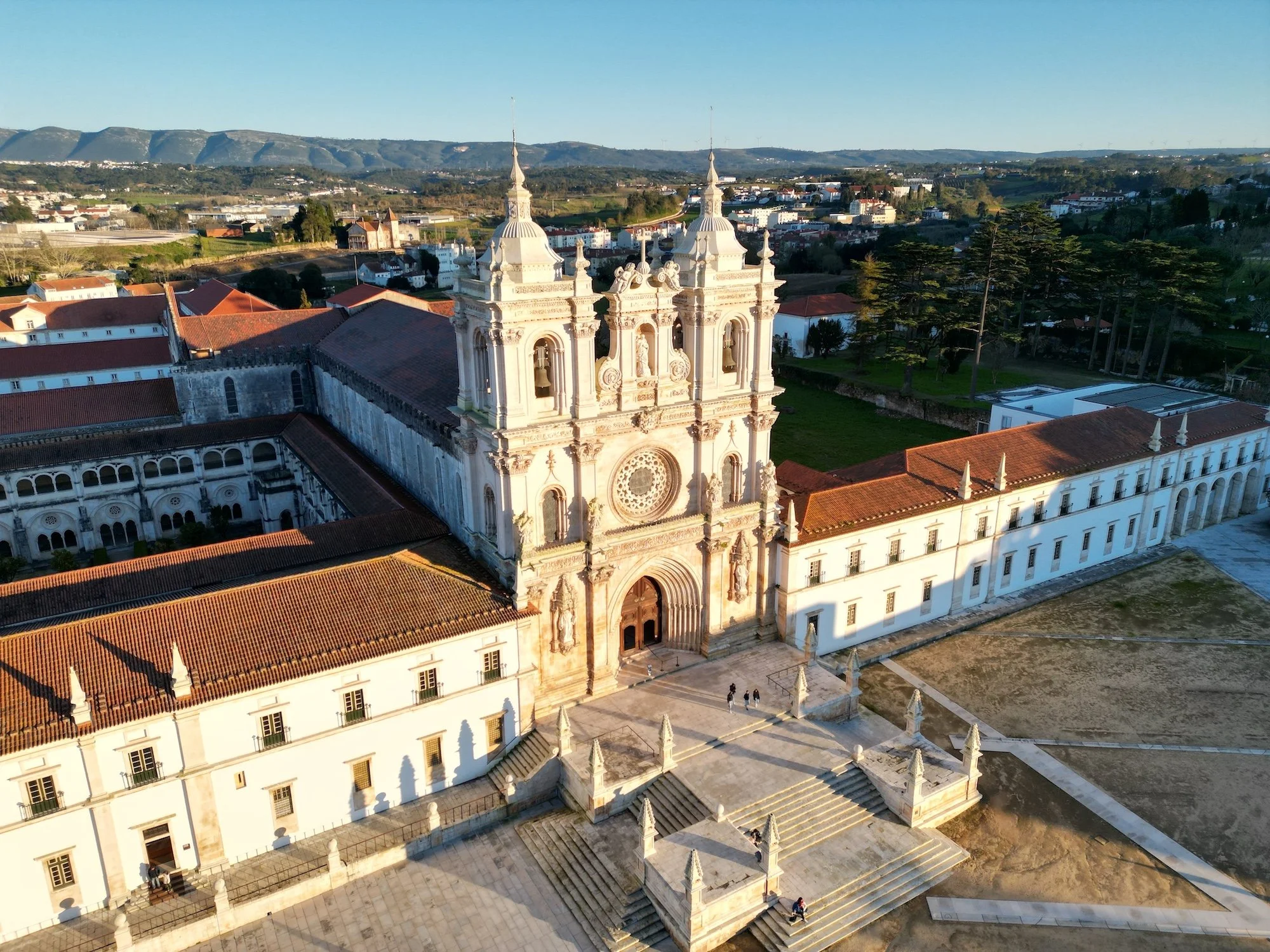
Alcobaça Monastery
Granted extensive lands by Portugal’s first king, Afonso Henriques, Alcobaça became a centre of monastic reform and territorial organisation. The Cistercians introduced advanced agricultural techniques, hydraulic engineering and systematic land management, transforming large swathes of central Portugal. Their approach combined spiritual discipline with practical innovation, reshaping landscapes that had already been cultivated for millennia.
Architecturally, Alcobaça’s church embodies Cistercian ideals of austerity and clarity. Stripped of excessive ornament, its soaring proportions prioritise light, space and acoustic purity. The monastery’s cloisters, refectories and dormitories articulate a disciplined rhythm of communal life structured around prayer and labour.
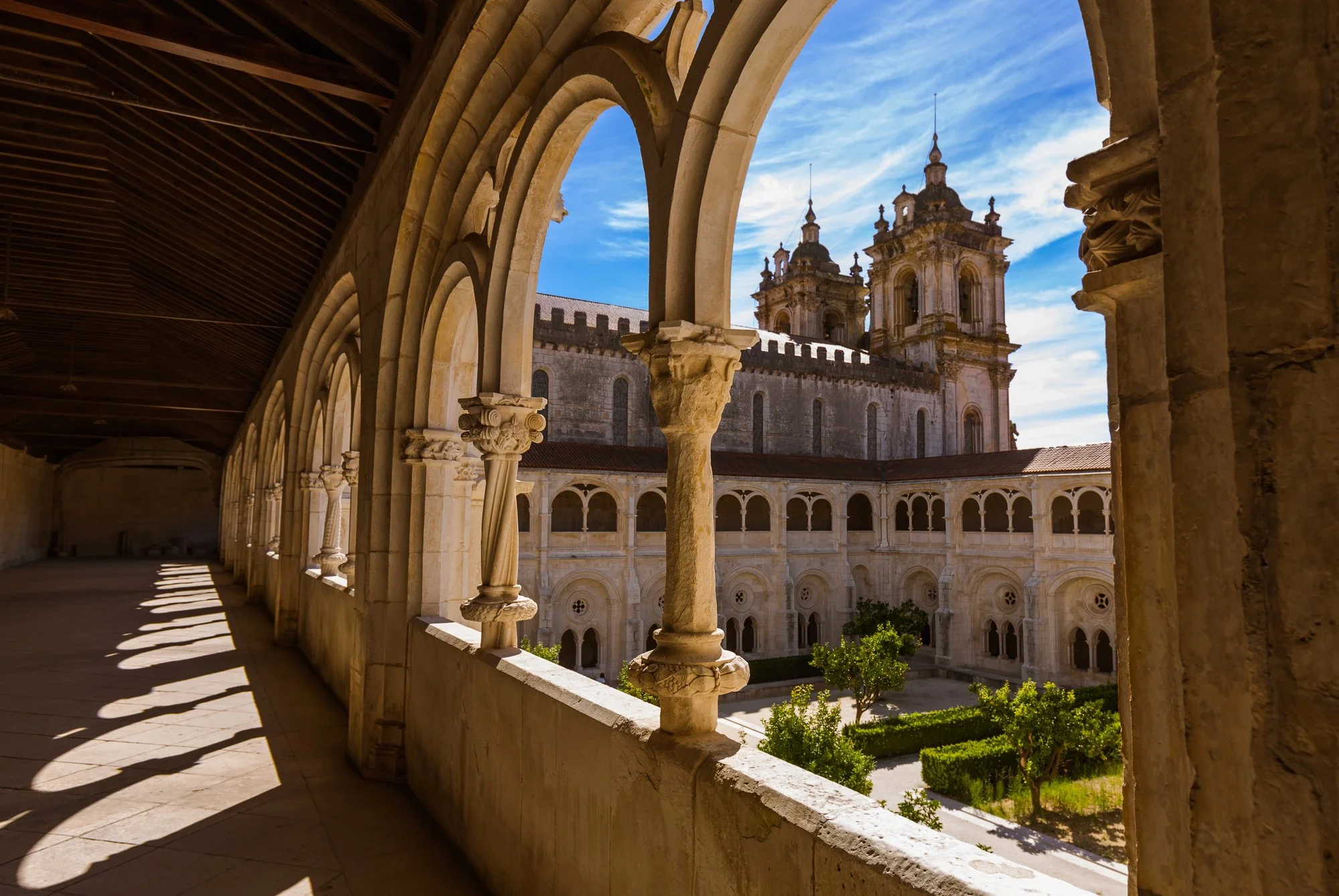
Cloister of the Silence, Alcobaça Monastery
Alcobaça’s influence extended far beyond monastic walls. It played a critical role in consolidating the Portuguese kingdom, binding spiritual authority to land, productivity and political power.
São João de Tarouca – medieval continuity
Portugal’s medieval transformation did not end with Alcobaça. The Monastery of São João de Tarouca, founded in the 12th century, is regarded as the first Cistercian monastery established on the Iberian Peninsula. Smaller in scale than Alcobaça, it occupies a valley in the north where monastic reform can be read not only in architecture but in land use.
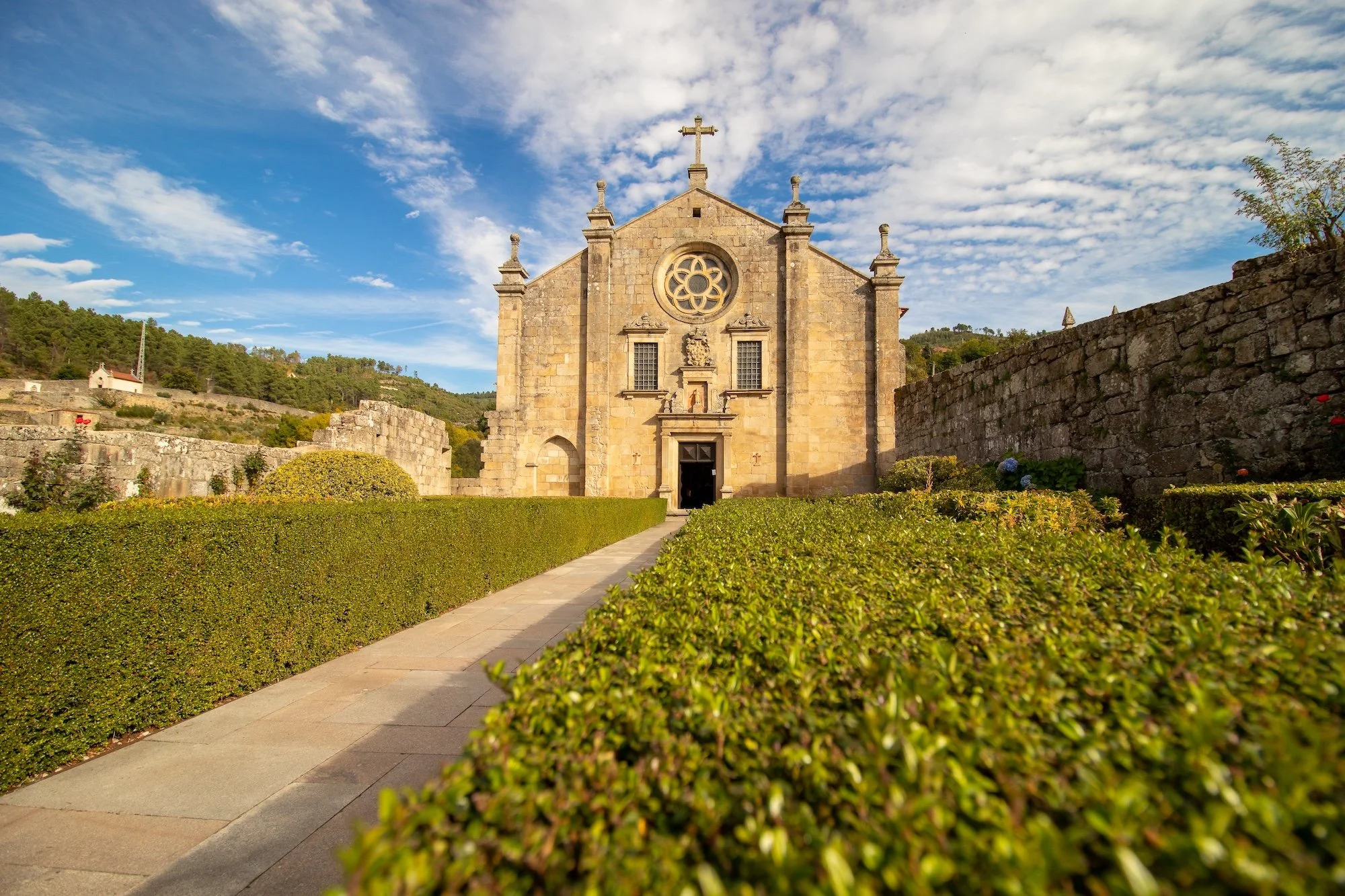
Church of the monastery of São João de Tarouca, Viseu
The Cistercians were not solely builders of churches; they were organisers of territory. Their model combined spiritual discipline with agricultural rationalisation. Through drainage systems, terracing and careful woodland management, they converted previously underused land into productive farmland. At Tarouca, the surrounding slopes and fields bear witness to this systematic approach. The monastery did not merely occupy the valley; it structured it economically and socially.
Seen in this context, monastic reform in Portugal was not confined to ecclesiastical practice. It was a practical reorganisation of landscape and economy, building upon earlier agricultural traditions while introducing new efficiencies. In doing so, institutions such as São João de Tarouca extended the long pattern already visible in Portugal’s past: inherited land repeatedly reshaped to meet new spiritual, political and economic needs.
Reading Portugal through time
When viewed together, these sites trace a long and continuous engagement between people and place. Megalithic monuments anchored prehistoric belief systems; Roman cities and villas reorganised land and society; medieval monasteries reshaped inherited landscapes through new spiritual and economic models. Each period built upon what came before, adapting rather than erasing earlier structures.
Engaging with Portugal’s hidden foundations encourages a slower, deeper way of seeing. Stone, soil, architecture and art become historical records through which long-term human and natural processes can be read. From dinosaur tracks on Atlantic cliffs to Palaeolithic rock art in the Douro Valley and Neolithic monuments in the Alentejo, from Roman cities to Cistercian monasteries, Portugal reveals itself as a landscape of accumulated meaning – one whose foundations reach far beyond the familiar chapters of its history.
A nation of many secrets away from the usual tourist haunts, Portugal awaits discovery.
Tour PORTUGAL
IMPERIAL LEGACY & VIBRANT PRESENT
This comprehensive 17-day tour, led by Dr Jeni Ryde, explores Portugal’s layered past – from its prehistoric foundations and Roman cities to the legacy of Moorish rule, Christian consolidation and the global reach of the Age of Exploration.
Alongside this history, we experience two of Portugal’s defining landscapes: the Atlantic’s dramatic edge and the carefully terraced vineyards of the Douro Valley, viewed from the river on a private cruise.