‘Mood Work’: Genevieve Carroll, Hill End Artist
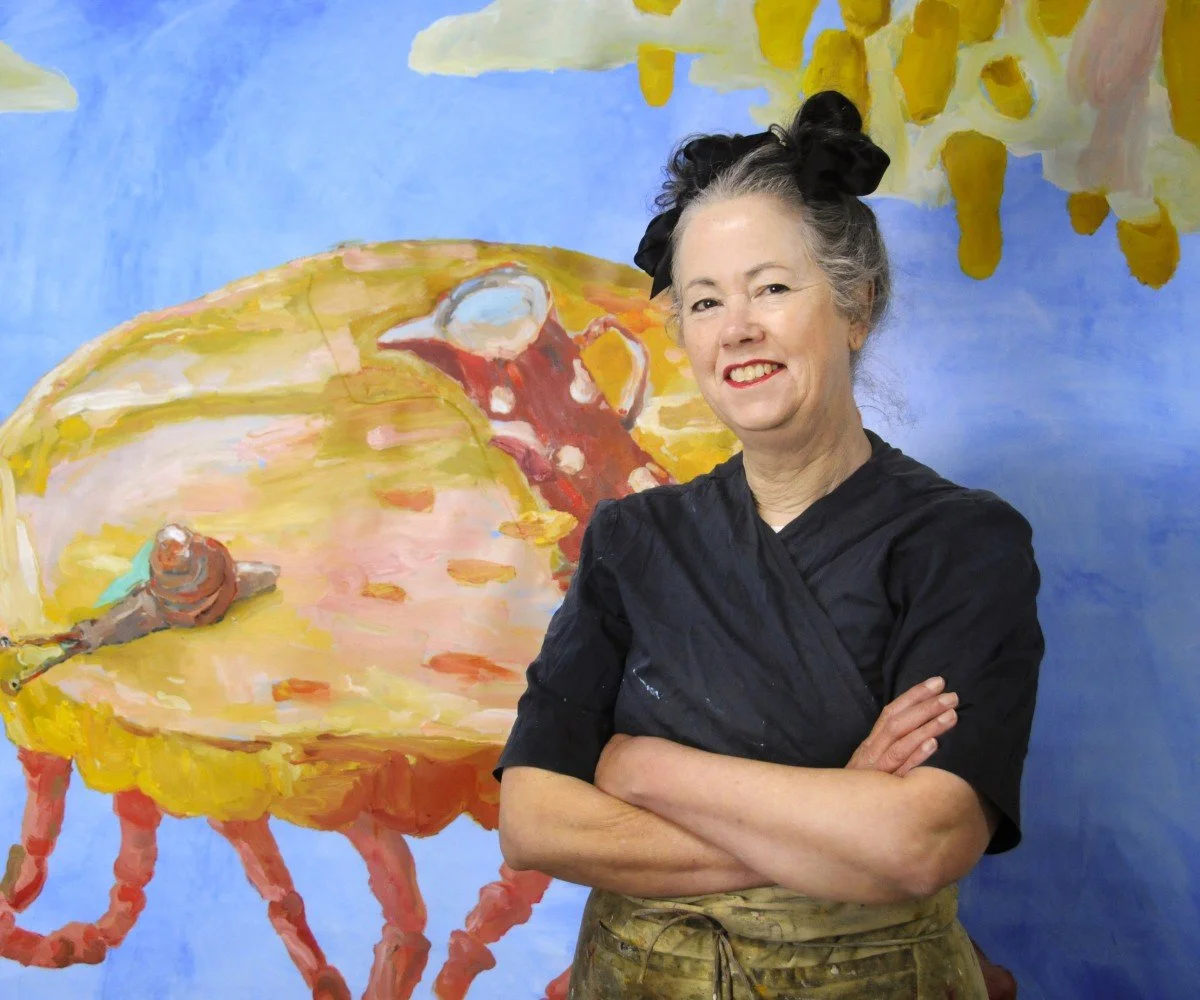
Genevieve Carroll in her studio. Photograph Bill Moseley
You arrive in the township of Hill End, New South Wales, from either Bathurst, Sofala or Mudgee.
Each road is different, but all are dramatic, winding, and mountainous. Cliffs of yellowish, primeval rock appear as you wind up the hills, the type of moonscape that must have surprised the artist-visitors who came here from Sydney in the 1940s in search of peace and inspiration.
Many travellers recount the same feeling of release and elation as they arrive at the terminus. The road drops its vertiginous air and you arrive in a wholly new place. A long avenue of fine, European trees, planted by local man Louis Beyer from 1878, greets you, the land becomes level and more domestic, and quaint miners’ cottages with their old-fashioned fences, flower gardens and fruit trees come into view. You have arrived in Hill End (formerly Bald Hills), literally the end of the road, as the only other way out is back through the ‘Bridle Track’, impassable to regular cars.
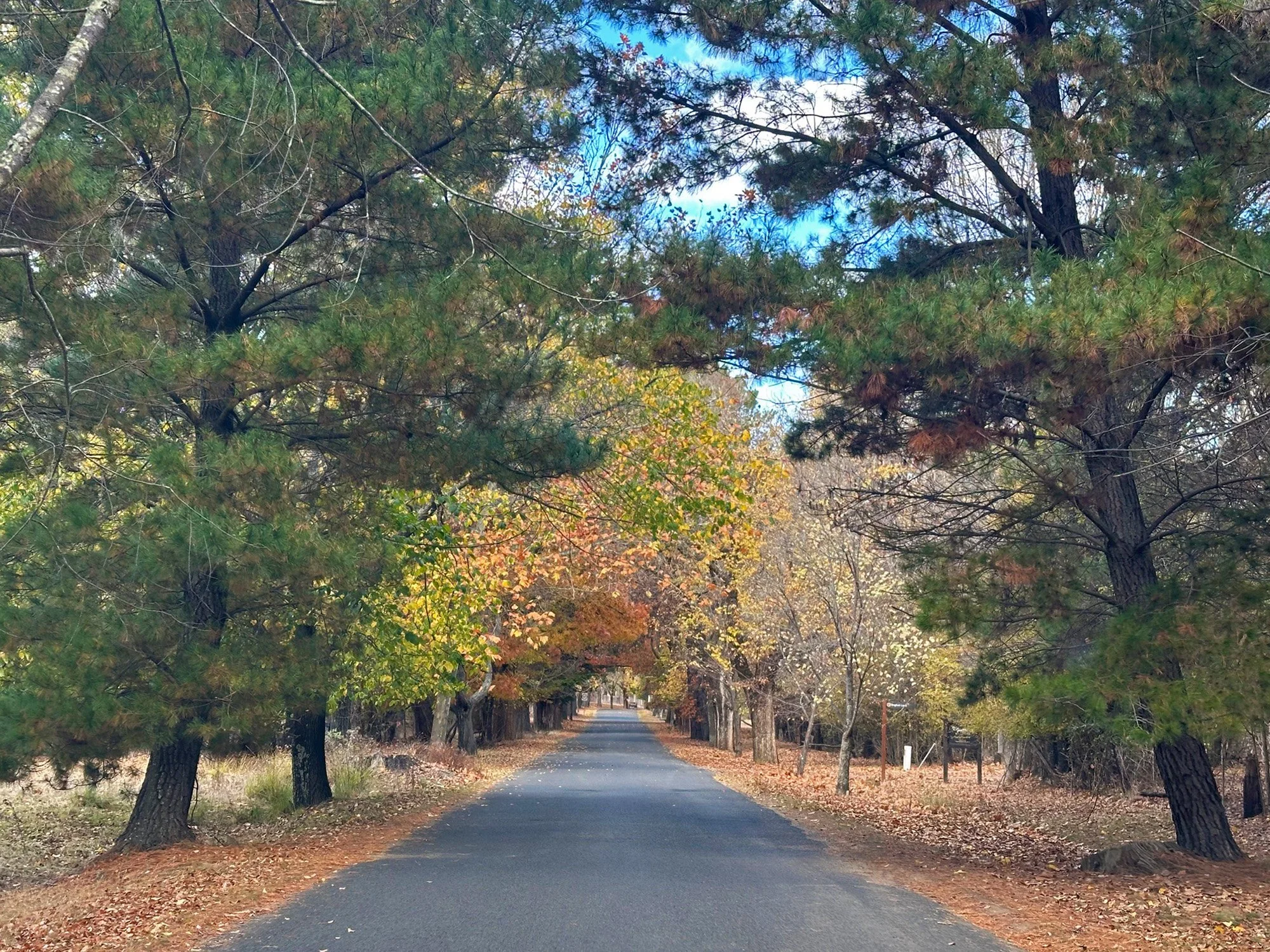
Autumn foliage arriving into Hill End, NSW. Photograph Peter McNeil
The air in Hill End feels fine and sharp, filtered by European leaves as well as the scent of pine and Eucalyptus. There is also the faint smell of animals - kangaroos, wild goats, domestic geese and curious lamas (the latter fenced), grazing on semi-open land as well as invading the gardens of those who are away. Deep-cut gutters lined with stone and little wooden bridges to various properties are picturesque and also practical. The sky is high and dramatic, ranging from a piercing blue to a menacing ochre-brown when the storm clouds brew, exactly as artists painted it in the past. Although very dry in summer, when it rains, the area from Mudgee to Hill End becomes a ‘glory of flowers and crops’.
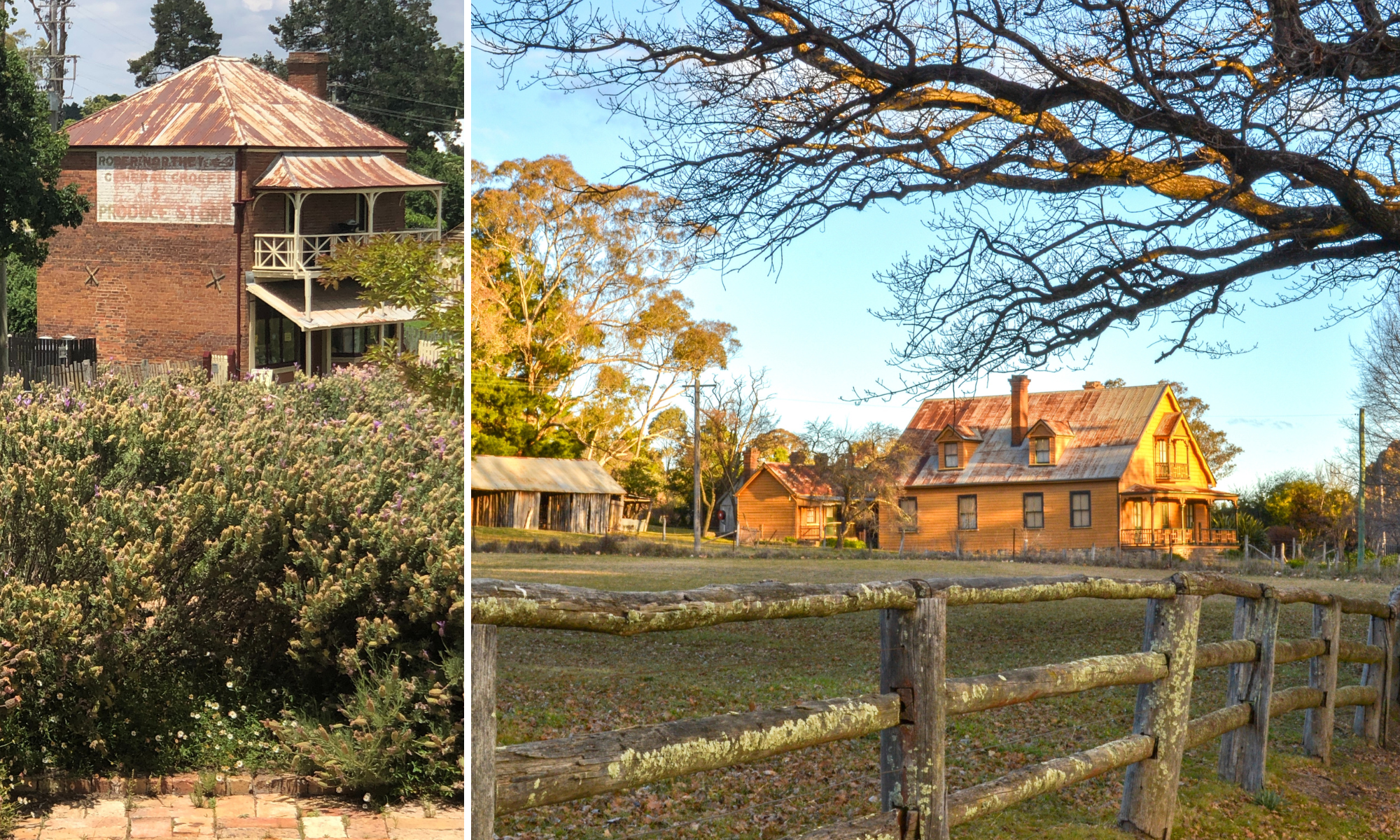
Historic buildings in Hill End, NSW
Hill End was New South Wales’s largest inland town in the 1860s, following the discovery of high-grade alluvial gold. Alluvial and quartz-reef gold requires long term investment and large diggings; hence a more permanent town was constructed at Hill End than in some parts of Australia where the fortune seekers lived mainly in tents and moved on quickly. Dozens of hotels, a shopping arcade and small, luxury stores, an oyster-house and doubtless a few brothels were constructed around picturesque streets and areas named for the Germans, English, Chinese, Danes and many other ethnic groups who settled in the environs.
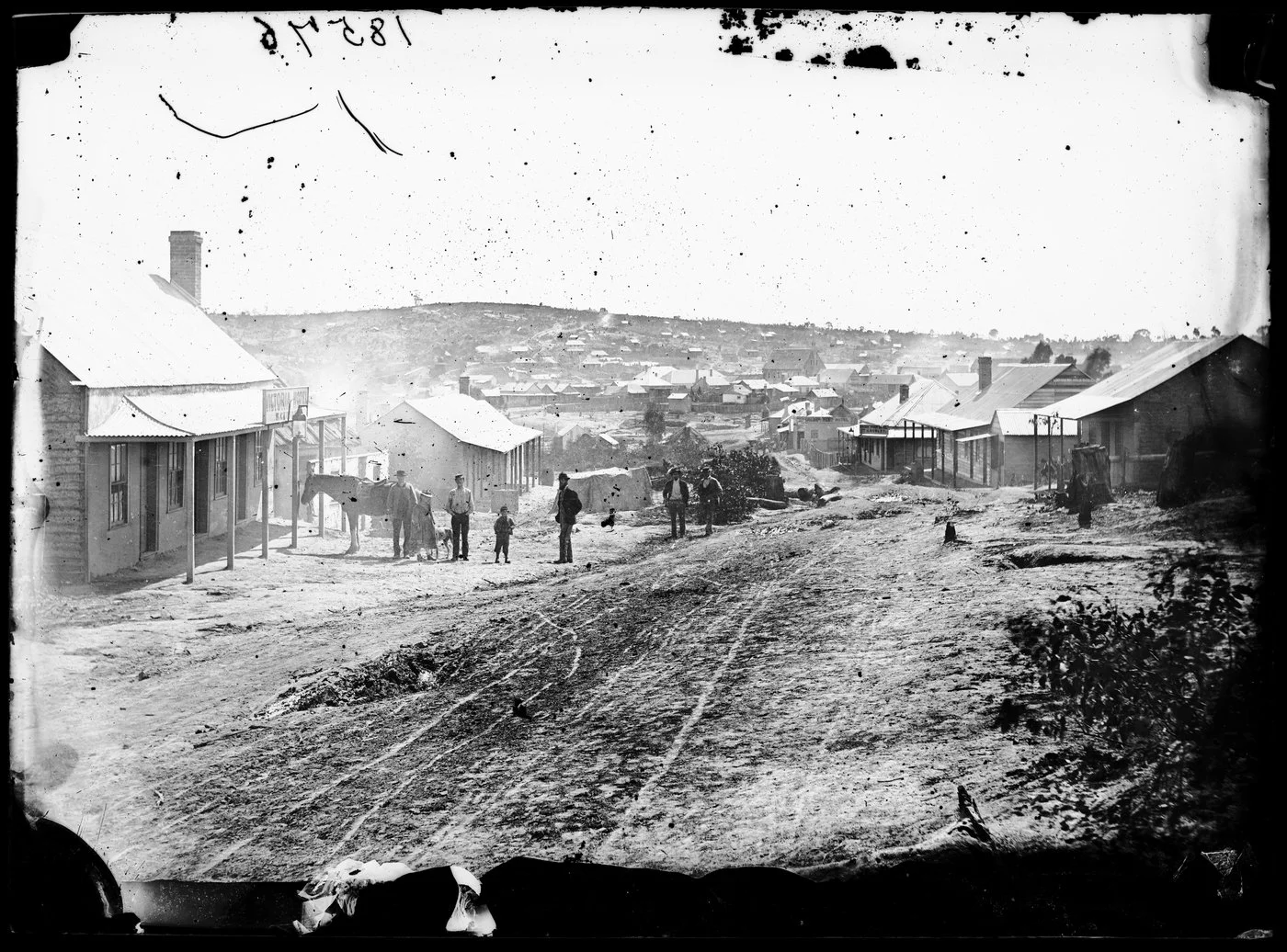
Reef Street, Hill End, NSW, c.1870-1875, State Library of New South Wales
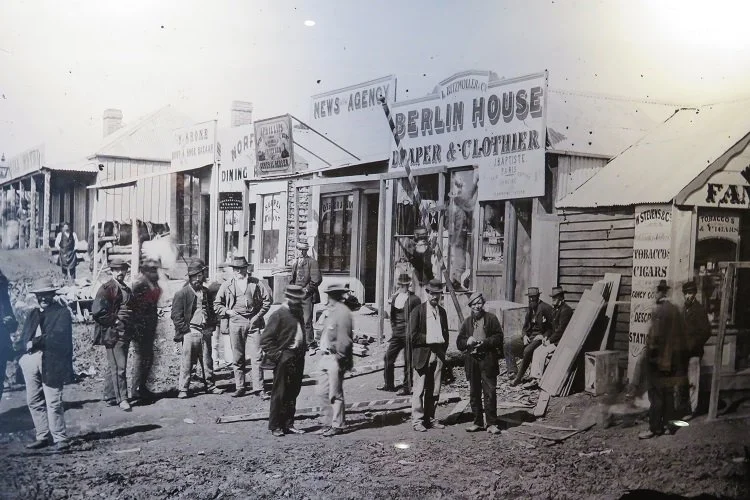
The bustling streets of Hill End. The Holtermann Collection
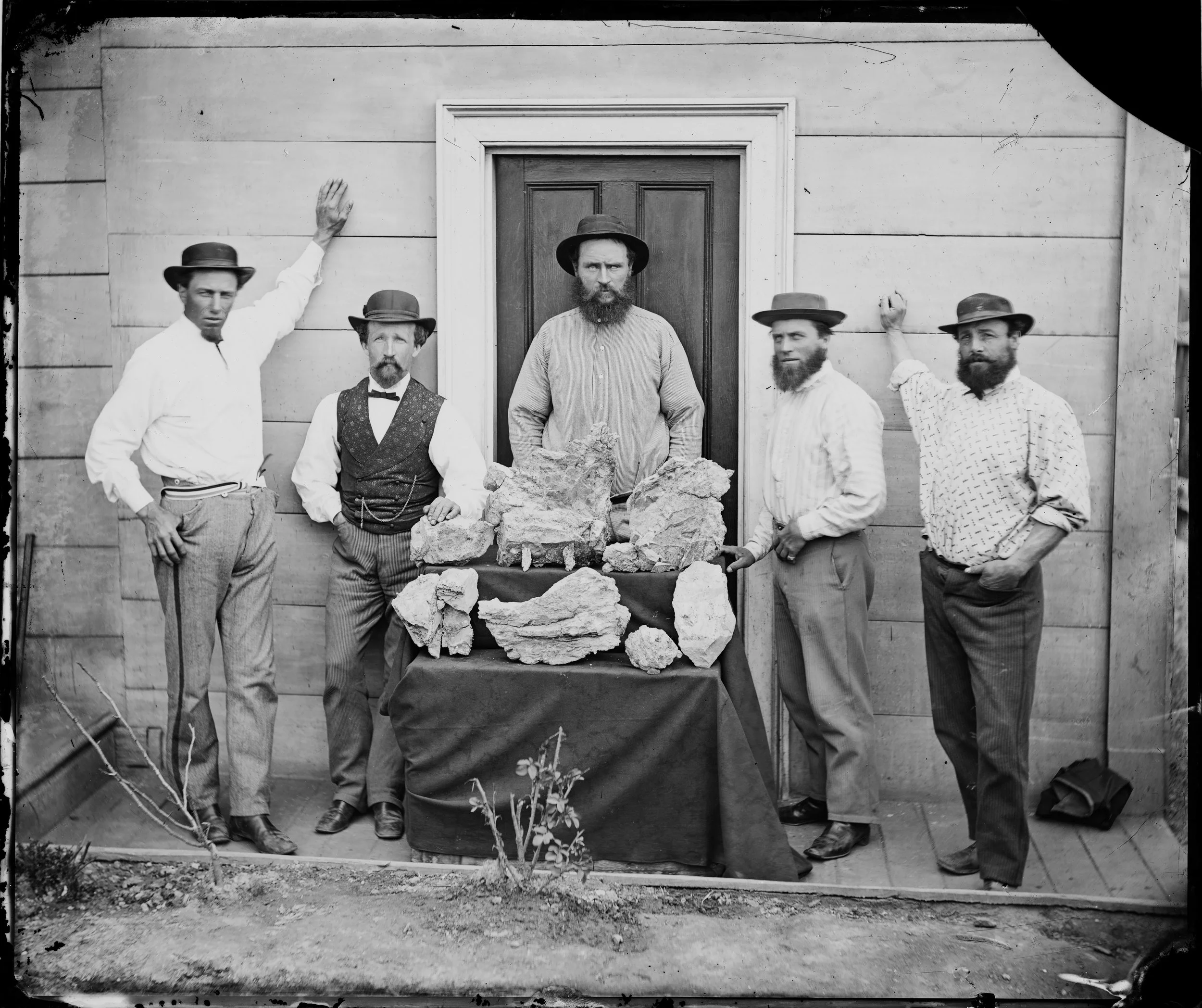
B.O. Holtermann (2nd from left), Richard Ormsby Kerr (centre) and Beyers (2nd from right), with reef gold from Star of Hope mine, 1872, attributed Henry Beaufoy Merlin, State Library of New South Wales
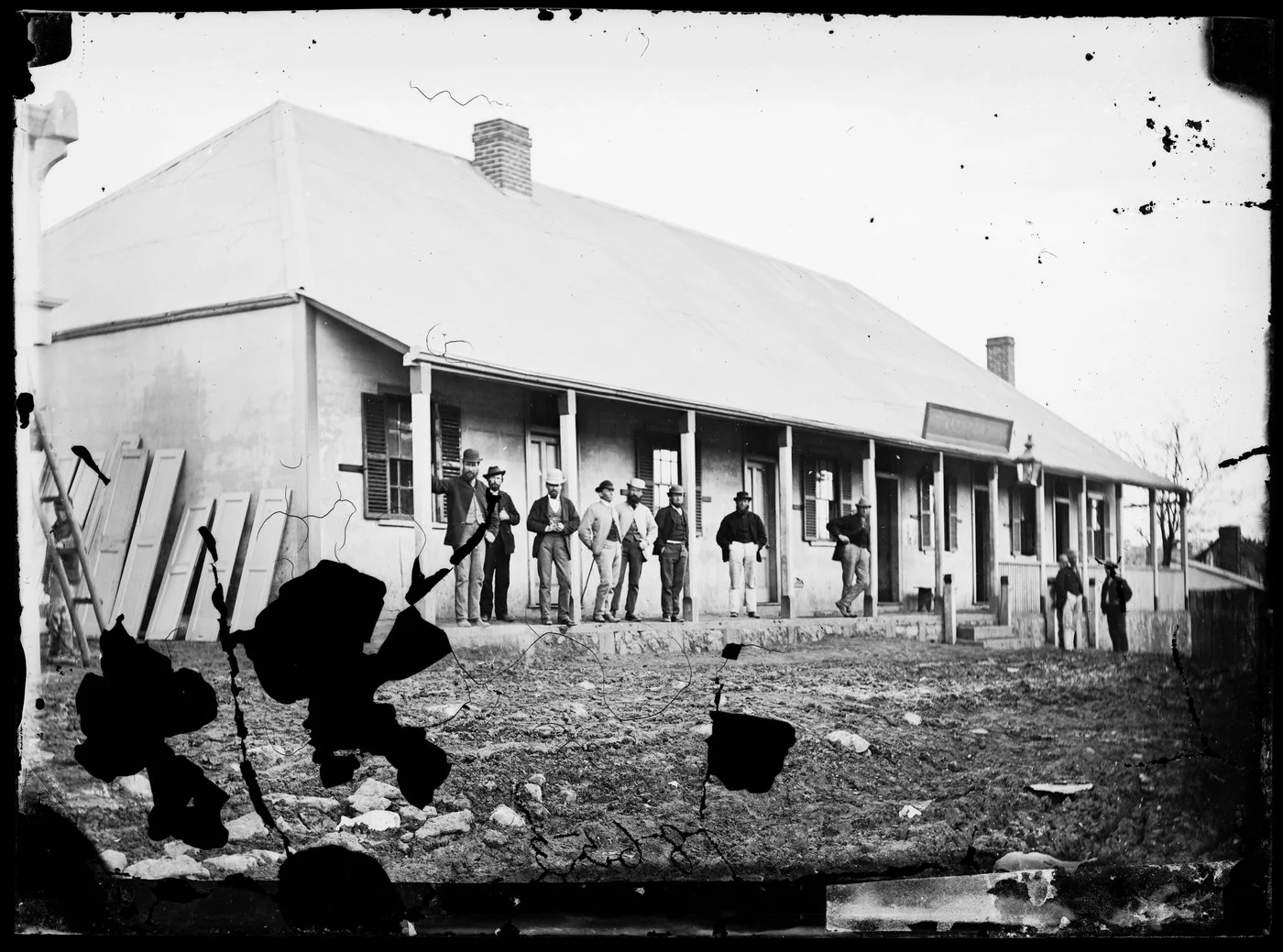
Wythes' Metropolitan Hotel, Hill End, NSW, c.1870-1875, State Library of New South Wales
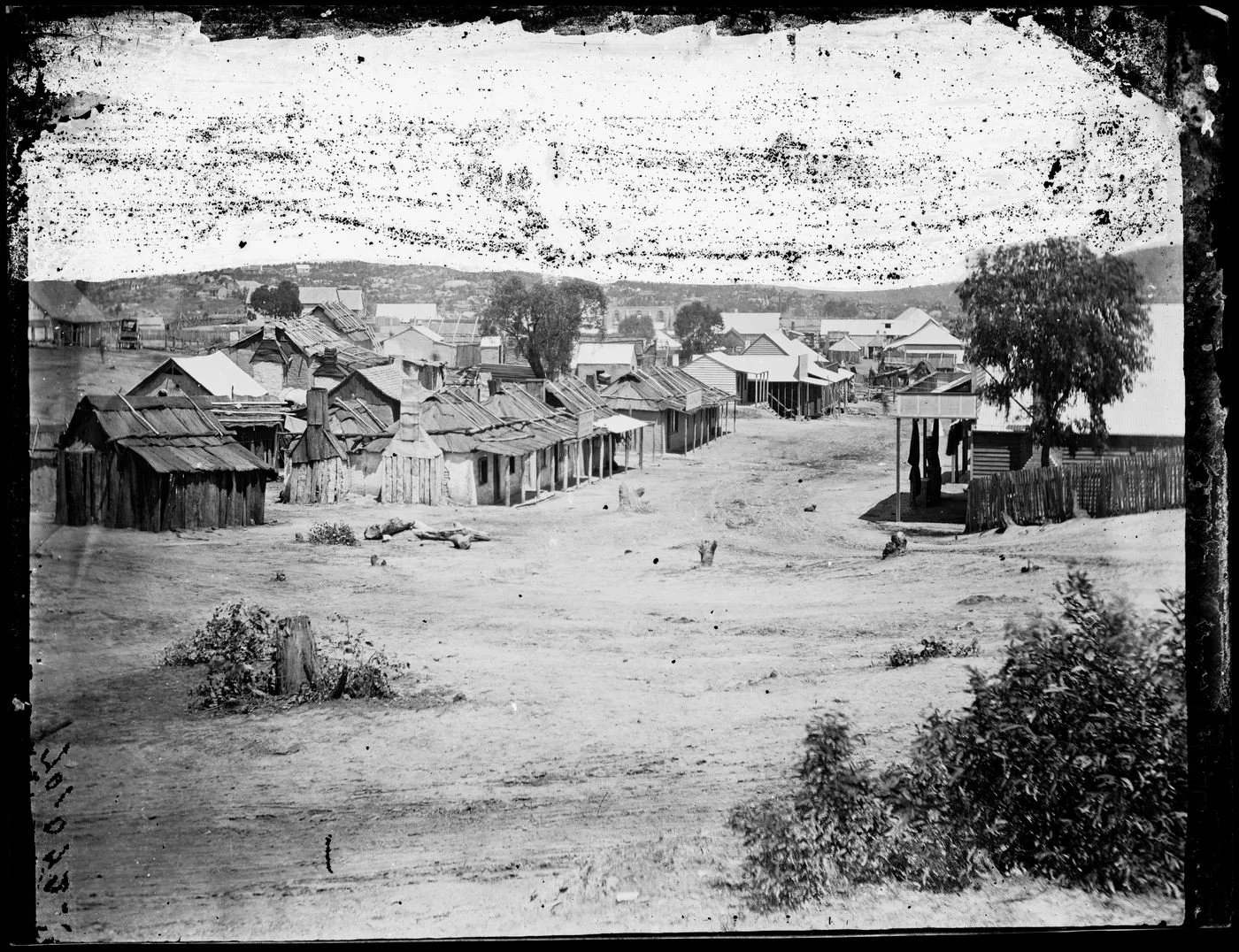
Early photograph of junction of Clarke Street (right) and Tambaroora Road (left), looking south, Hill End, NSW
By the 1890s, the rush was over, the town was diminished and many locals worked as fencers, rabbiters and other subsistence jobs. The road in and out was untarred and electricity was not provided until the 1960s.
The inhabitants were intrigued when the first artists arrived in the 1940s to purchase simple cottages, some thinking that they might be from the tax office. The new arrivals included Russell Drysdale, Donald Friend and the artist/critic couple Jean Bellette and Paul Haefliger, who were much visited by still-life and landscape painter Margaret Olley and Jungian artist David Strachan.
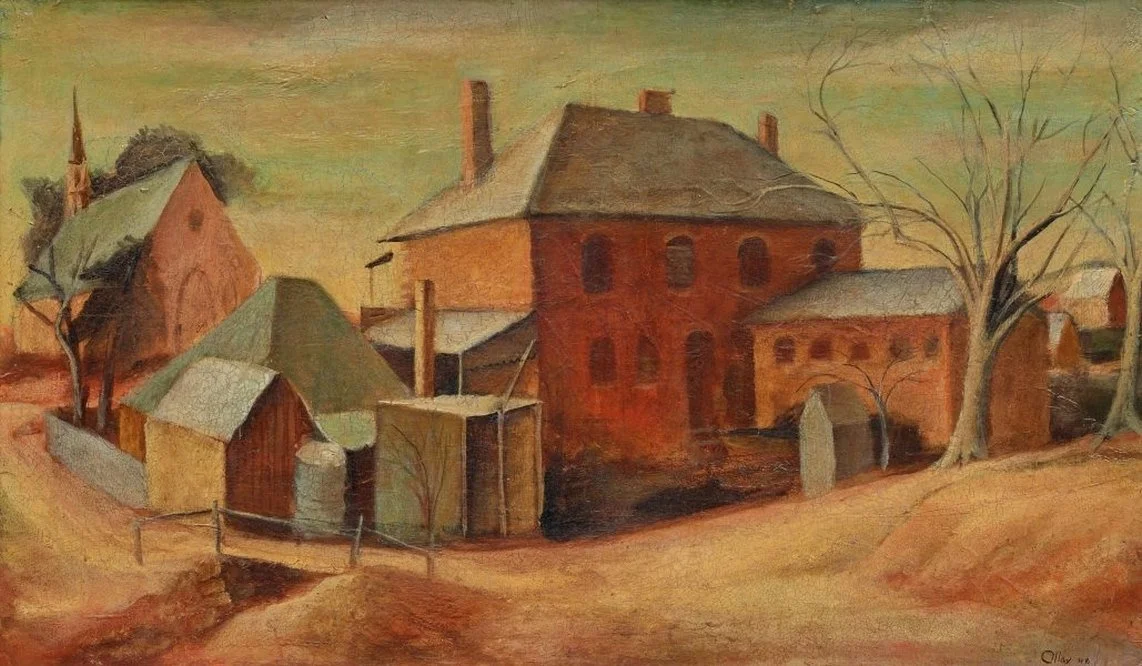
Margaret Olley, Backbuildings, 1948, oil on board, Art Gallery of New South Wales, Sydney
Artists gently restored and extended older cottages, built gardens, found old Victorian tiles and cast iron which artists such as Olley turned into decorative stove surrounds and fern gardens. In later decades they were joined by John Olsen, Brett Whiteley, John Firth-Smith and others. All were fascinated by the ‘ready-made surrealism’ of the collapsing nineteenth-century architecture, some modest and some more substantial, surrounded by eroded gold diggings that Drysdale painted as if it were a mystical outback, whereas the town is only 80 kilometres from the city of Bathurst.
The National Parks authority took charge of that part of Hill End which was not freehold land in the 1960s, demolishing many structures but also making the town viable as a tourist destination. In the 1990s, ‘Parks’ as locals call the organisation, began to issue preservation leases for 30-40 years, encouraging a new generation of artists and creative practitioners to breathe new life into this peaceful but sometimes harsh setting.
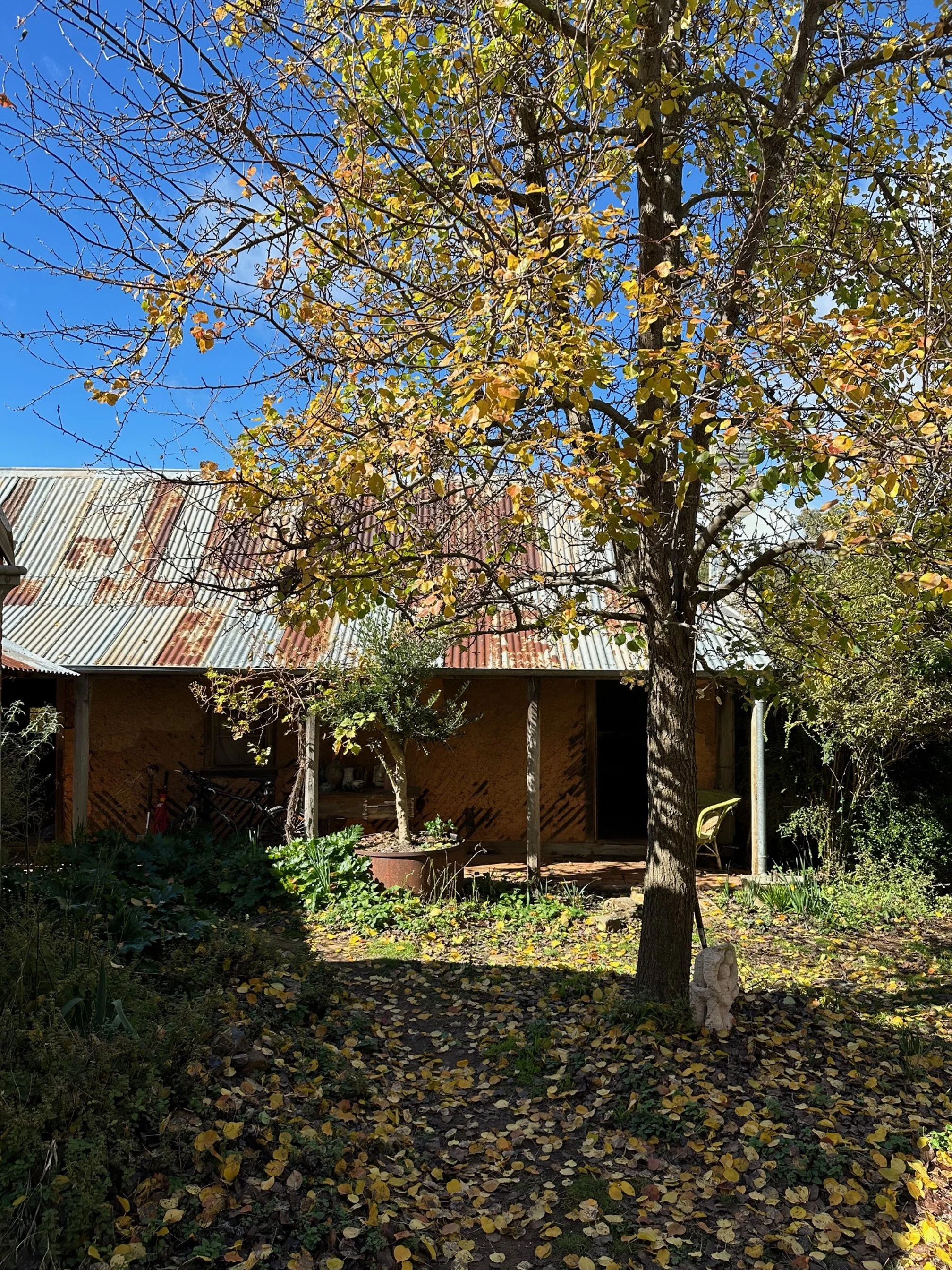
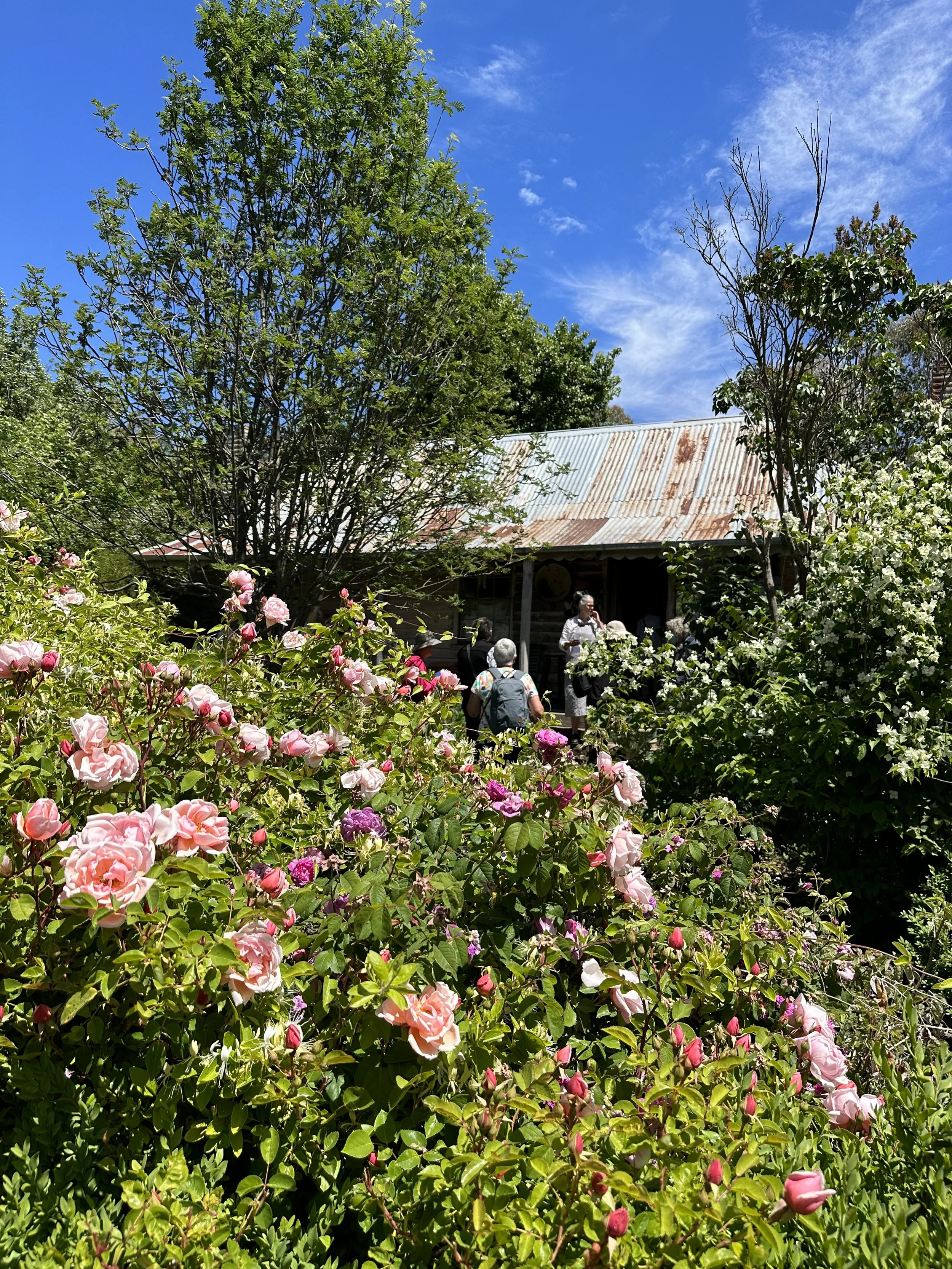
The tiny village of Hill End is both historic and charming, but to live in such an isolated area with a harsh Summer and Winter climate requires adjustment. Artist Genevieve Carroll, a long term resident there, has built a beautiful life for herself with partner Bill Moseley, trained as a ship builder and now photographer and print maker, developing Hill End Press with old printing equipment, and making art, photography and poetry. Both are heavily involved with the Hill End Analogue Festival, which in 2025 featured the work of 40 photographers and collector-artists.
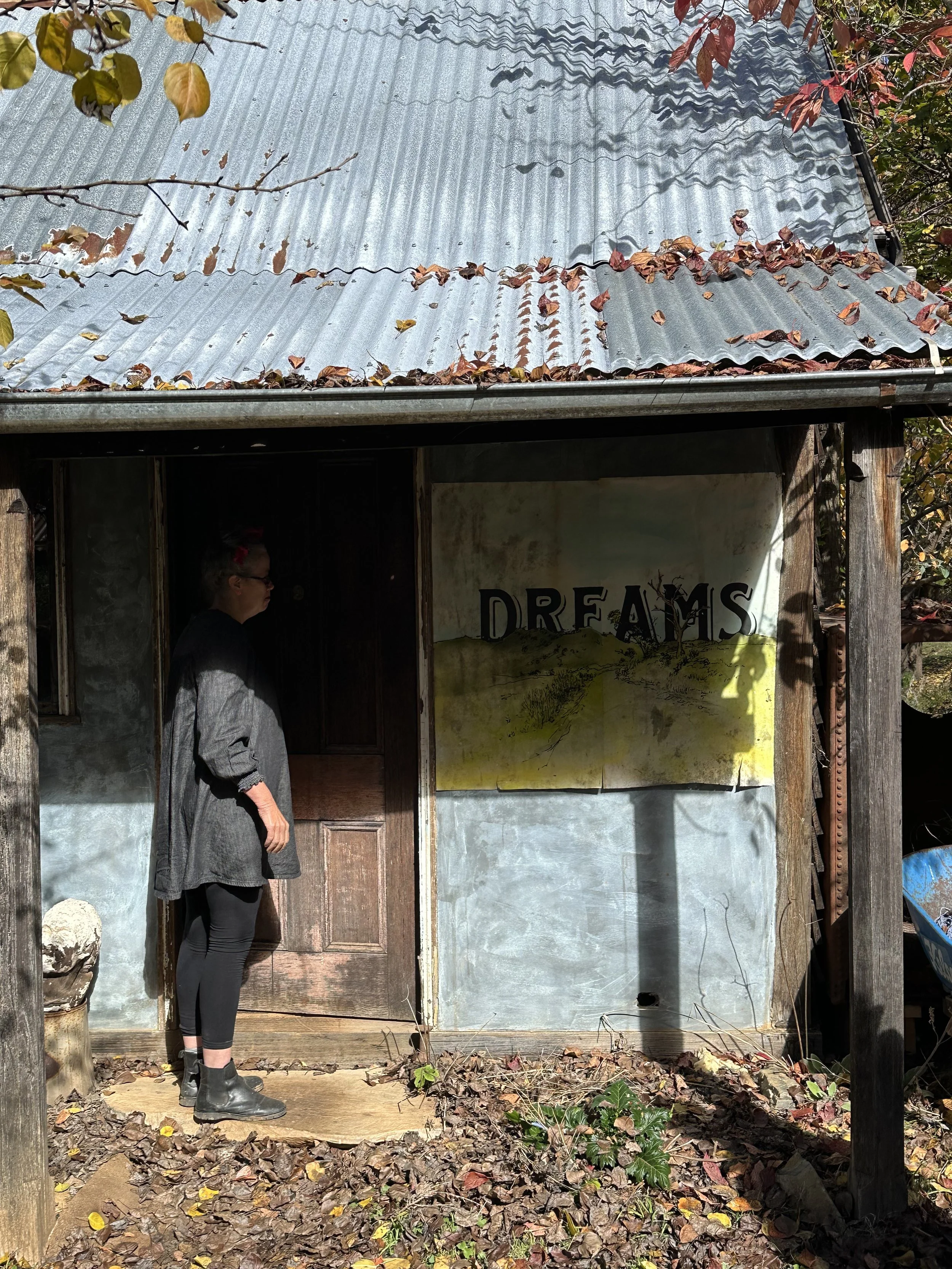
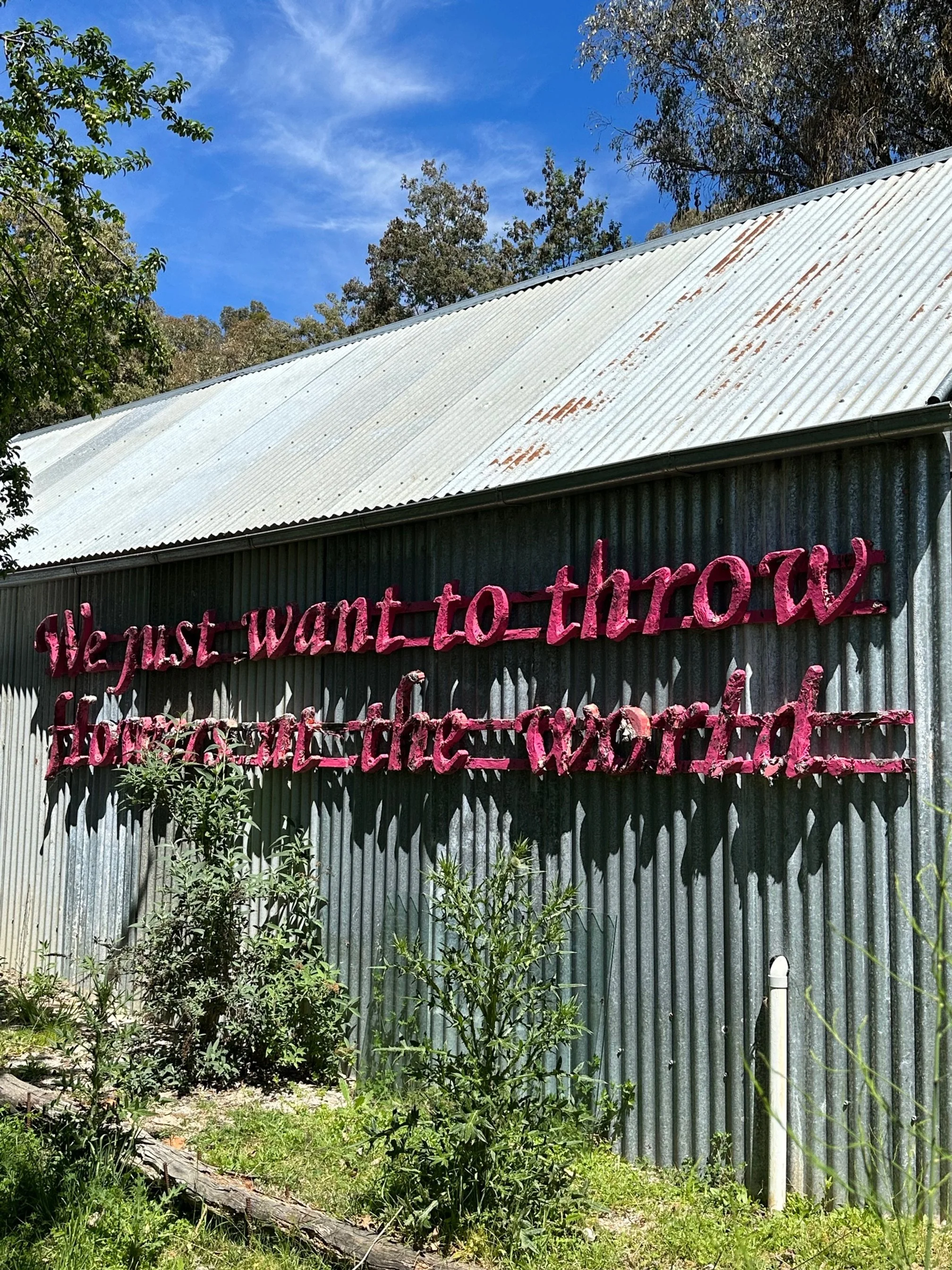
Genevieve Carroll is one of the newer generations of Hill End artists, being born in the 1960s. As a child she was likely bored at school and drew watercolours over her lessons. Reading was always important: ‘poetry is my whole foundation’, she once told me. Her father was a professional window dresser: as a child she played with his papier-mâché. As a young woman she went on to paint, stencil and write on the walls of her first homes. Environments and mystical atmospheres are very important to Carroll.
Carroll attended National Art School as a mature student, and moved with partner Moseley to the remote former gold rush town about fifteen years ago. There they established a new life living between a series of pavilion-like miner’s huts and a studio. The outside in Hill End is nearly always inside, too, with bush rats, winter winds, summer snakes and high keyed skies moving with regular rotation in and around the village. Carroll makes paintings and writes poetry that respond to place, fusing still-life with genre, myth, and the human figure.
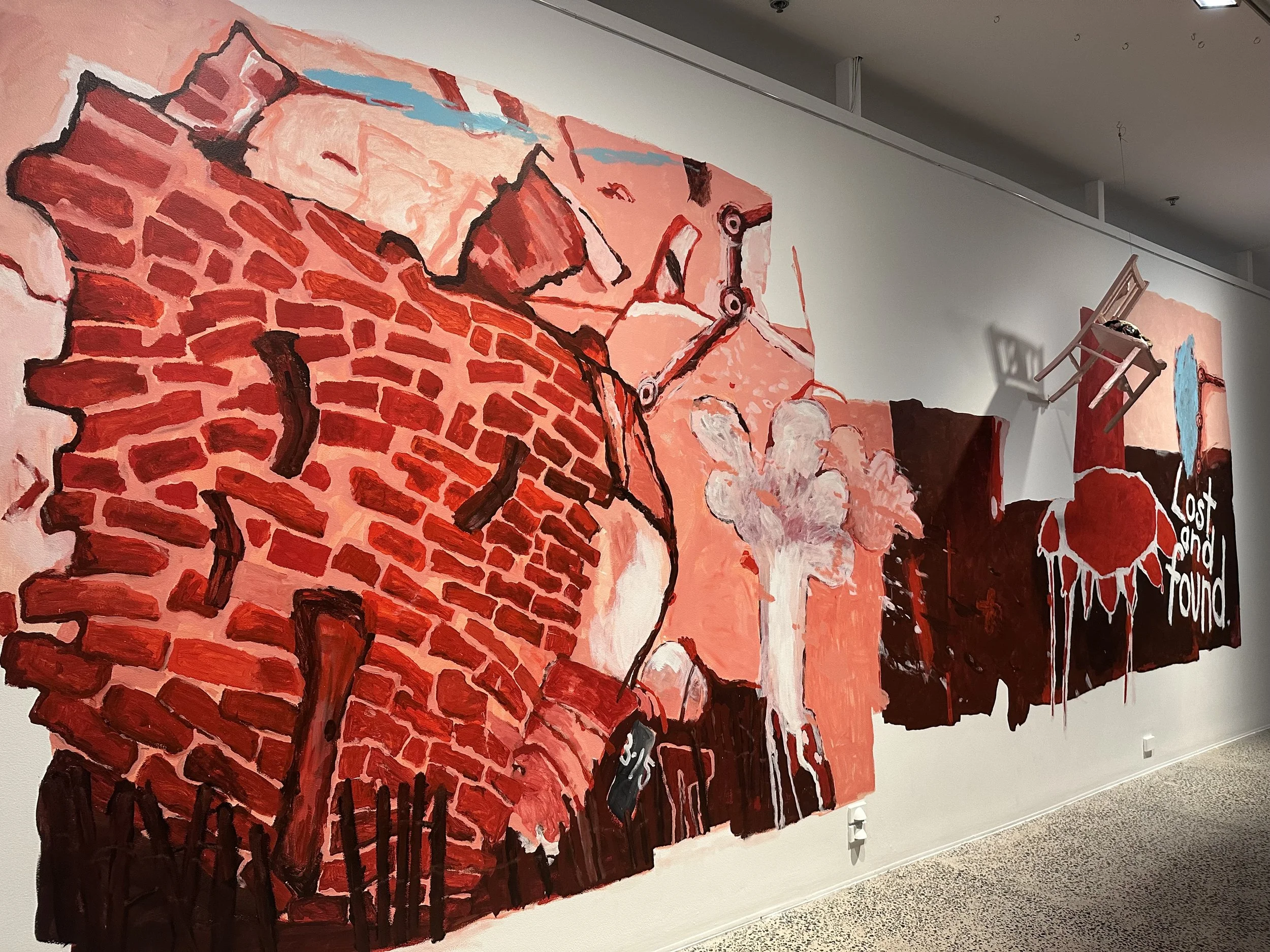
How to sit comfortably, 2025. Mural with drawing and chair. Genevieve Carroll. Hill End
The harshness of Hill End
Hill End and surrounds are scattered with refuse. Going for her daily walk, Carroll might dislodge a shard of ceramic or antique glass under her shoes. Although ostensibly exquisite with remnant almond and lilacs in Spring, or Lombard poplars in Autumn, a melancholy quality underscores the loneliness and isolation of the place. A studied silence that local potter-artist Lino Alvarez calls ‘the deafness of Hill End’ remains: gone are the noise of the stampers that crushed quartz, the drunken shouts of miners leaving the pubs, or the noise made by the First Nations inhabitants who often could be heard, but not seen, by the early colonists in this region.
Mood work
Modernist, fragmentary poetry is incredibly important to Carroll, who undertook a graduate course during lockdown and who now actively composes and presents her poetry alongside her paintings. Carroll is very inspired by early women modern poets such as Virginia Woolf, writers who privileged the everyday and domestic in their writing, art and design work. The repetitive notes which privilege the everyday beauty of other poets including Gertrude Stein, Sylvia Plath, Seamus Heaney, Louise Glück and Alice Oswald influence her world. There are of course many artistic inspirations too: Goya, the Symbolists such as Odilon Redon and Edgar Allan Poe, Munch, Picasso’s Cat with Dead Bird (1939), Georgia O’Keefe, Frida Kahlo and Philip Guston.
To me there is also a little of the Edwardian ‘Bloomsbury’ set present in the ‘English Cottages’ inhabited by Carroll and Moseley. The Omega Workshops, an English craft workshop established in 1913 by Roger Fry with Vanessa Bell and Duncan Grant, produced limited edition furniture, textiles and fittings. It was as much about politics, in their case anti-war activism, as art and design. At Charleston (the country house near Lewes, Southern England, inhabited by the Bloomsbury set in the 1920s-30s) they painted and repurposed an upturned kitchen colander into a chandelier. So Carroll, too, repurposes her own soft sculptures made from antique textiles as light fixtures. When I visited, Genevieve had repainted the sitting room walls in a rich sage and gold. Is the home an extension of the couple’s art, or the art a fusion of life and home? Artists always help us see things we might not ourselves. The interior to Carroll is a space of meditation and reflection.
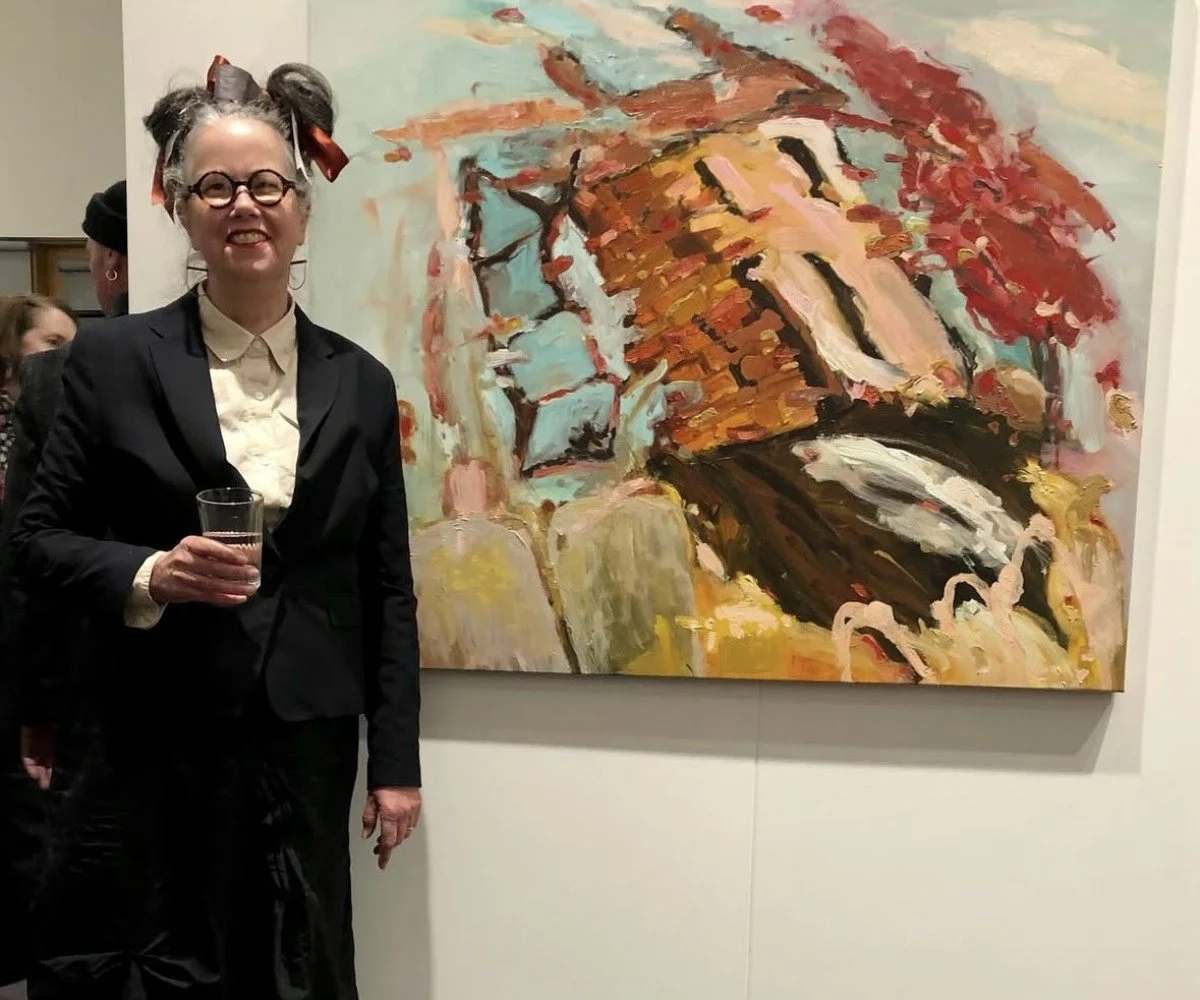
And the home waved goodbye, 2025. Genevieve Carroll. Photograph supplied by artist
The art of Genevieve Carroll is deeply personal. Looking at her work, we also think more about how we might live our own lives. Perhaps more simply, with more care, deliberation and interest in our own links to the past. As the couple develop a series of visiting art residencies, Hill End begins a new journey with them. You might even hear Carroll recite some of her own poetry there.
Art & Artists
of NSW’S Central West
The Spirit of the Land
Across this seven day tour, we explore a wide variety of established artists, photographers and ceramicists including Genevieve Carroll, Bill Moseley, Amanda Penrose-Hart, Lino Alvarez and Kim Deacon in studios and galleries across Hill End, Bathurst, Orange, Millthorpe and Mudgee.
Genevieve Carroll exhibits at King Street Gallery on William, Sydney.
Peter McNeil leads the art tour, ‘Art and Artists of the Central West’, to Hill End and its surrounds with Academy Travel, Sydney, twice annually. In 2024 he was invited by Carroll to write the catalogue essay for her exhibition ‘The Wattle Room – Chapter 12 – Hill End: The most curious landscape’ at King on William, July-August 2024.
With thanks to Genevieve Carroll, Bill Moseley, Lino Alvarez, Kim Deacon and many other Hill End artists; conversations with the author, 2022-2025, and for the awarding of two Bathurst Regional Art Gallery ‘Murray’s Cottage’ Hill End Residencies.
Watch - Dist. Prof. Peter McNeil takes us on a walking tour through Hill End…